



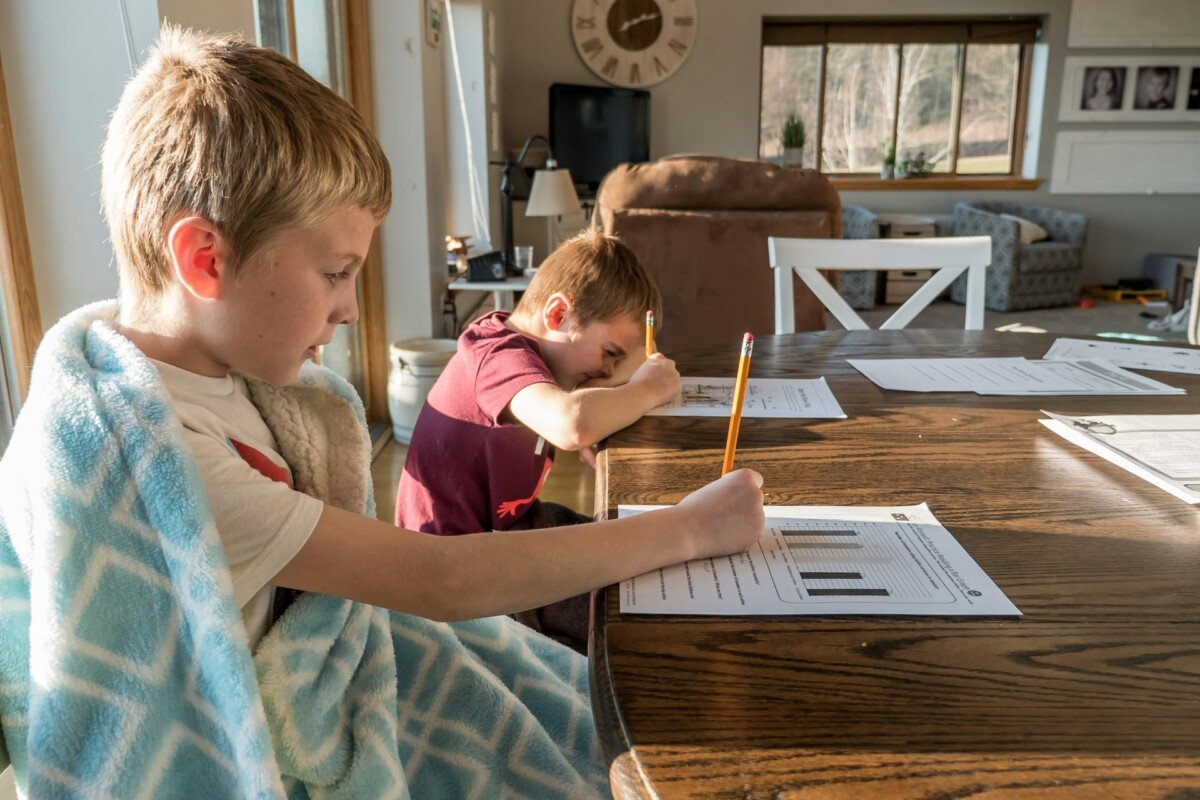
Your child sits down to do homework. Within two minutes, the pencil is rolling across the desk. Within five minutes, they need a drink of water. By ten minutes, they are staring at the ceiling, poking a sibling, or asking if they can “just check something quickly” on a phone or tablet. The homework that should take 30 minutes stretches to an hour and a half, filled with battles, reminders, and frustration on both sides.
If this sounds familiar, you are not alone, and your child is not being deliberately difficult. Difficulty sustaining attention on tasks that are not intrinsically interesting is developmentally normal, especially for children between the ages of 5 and 12. A 2026 paper published in the Early Childhood Education Journal (Berg et al.) confirmed that attentional skills develop gradually and that problems with sustained attention in elementary school are associated with lower academic achievement in high school. The research is clear: attention is not simply a character trait a child either has or does not. It is a skill that can be supported, trained, and structured.
The Centers for Disease Control and Prevention (CDC) notes that physical activity, adequate sleep, and proper nutrition are among the foundations of children’s attention and cognitive function. A 2026 study (Lakicevic et al.) found associations between physical fitness and executive functions, including working memory and cognitive flexibility.
This article provides a practical, structured system for creating a homework routine that works with your child’s attention patterns rather than against them. It is written for parents, guardians, and caregivers of children in primary and secondary school who struggle with focus during homework time.

Why Children Get Distracted During Homework
Before building a routine, it helps to understand what is happening when a child loses focus. Distraction during homework is rarely about laziness or defiance. It usually has specific, addressable causes.
Internal Causes
Fatigue. After a full school day, children’s mental energy is depleted. Asking them to do their most demanding cognitive work when they are most tired is a structural mismatch. The American Academy of Pediatrics recommends 9 to 12 hours of sleep for children aged 6 to 12 and 8 to 10 hours for teenagers. Children who consistently get less are more likely to struggle with attention.
Hunger. Blood sugar drops in the afternoon. A child who has not eaten since lunch may genuinely lack the physiological fuel to concentrate. This is a common and easily fixed cause of homework distraction.
Emotional state. Anxiety about the task, frustration with difficulty, social stress from the school day, or worry about unrelated problems all compete for a child’s attention. A child who seems distracted may actually be preoccupied.
Task difficulty mismatch. Work that is too easy causes boredom. Work that is too hard causes frustration and avoidance. Both result in distraction. The ideal difficulty level is challenging enough to require effort but achievable enough that the child can succeed with reasonable focus.
External Causes
Environmental distractions. Noise from siblings, television in another room, a phone nearby, visual clutter on the desk, or people moving through the homework space all compete for a child’s attention.
Lack of routine. When homework time is unpredictable (sometimes before dinner, sometimes after, sometimes at the kitchen table, sometimes on the couch), the child has to make decisions about when and how to start each day. This uncertainty increases the psychological barrier to beginning.
Screen proximity. A phone, tablet, or computer within reach is the single most powerful distractor for school-age children. Even a device that is turned off but visible on the desk can pull a child’s attention through the anticipation of checking it.
The Homework Routine Framework: Six Components
Component 1: The Transition Period (10 to 20 Minutes Before Homework)
Children cannot switch directly from the stimulation of the school day or play time to the focused concentration that homework requires. They need a transition.
What the transition looks like:
- Arrive home (or finish play/screen time)
- Have a snack and a drink of water
- Use the bathroom
- Put away their school bag and change if needed
- 5 to 10 minutes of light physical movement (stretching, walking outside, bouncing a ball)
The CDC lists improved attention and memory among the documented benefits of physical activity for children. Even five minutes of movement before sitting down to study helps reset a child’s focus.
What to avoid during the transition: Starting screen time (television, phone, tablet, video games). Screens provide such intense stimulation that homework feels dull by comparison. Going from a screen to homework makes the focus problem significantly worse. If screens are allowed after homework, they become an incentive. If they come before, they become an obstacle.
Component 2: The Designated Homework Space
A consistent, distraction-reduced space is one of the most impactful changes a parent can make.
Setting up the space:
| Element | What It Should Be | What to Remove |
|---|---|---|
| Location | A quiet, consistent spot used for homework every day | Random locations (couch, bed, kitchen during cooking) |
| Surface | A clean table or desk with enough room for materials | Clutter, toys, unrelated items |
| Lighting | Well-lit, preferably natural light or a desk lamp | Dim or harsh overhead fluorescent lighting |
| Seating | A comfortable but upright chair (not a bed or couch) | Positions that encourage sleepiness or fidgeting |
| Supplies | Pencils, erasers, ruler, paper ready and within reach | The need to get up repeatedly to find supplies |
| Devices | Completely absent unless needed for a specific assignment | Phones, tablets, game devices, television in sight |
| Noise | Quiet, or soft consistent background sound (white noise) | Television, music with lyrics, conversations |
The key principle: The space should signal “this is where we do homework” so clearly that sitting down in it triggers a mental shift toward focus. Consistency in location builds this association over time. If the child does homework in a different spot every day, no such association forms.
Component 3: The Structured Work Session
This is where most homework routines fail. Parents tell children to “do your homework” and expect them to work continuously for 30 to 60 minutes. For a child who struggles with focus, this is an unrealistic expectation.
The work-break rhythm:
Instead of one long block, use short, timed work sessions with built-in breaks.
For ages 5 to 8: 10 minutes of work, followed by a 3-minute break.
For ages 9 to 12: 15 to 20 minutes of work, followed by a 5-minute break.
For ages 13 and up: 20 to 25 minutes of work, followed by a 5-minute break.
How it works in practice:
- Set a visual timer (a physical timer or a phone timer placed face-down out of reach). Children respond better to visual timers than to verbal time estimates because they can see the time shrinking.
- During the work period, the child works on one specific task (not “homework” generally, but “the math worksheet” or “reading pages 24 to 28”).
- When the timer goes off, the child takes a break: gets up, moves around, gets water, stretches. No screens during breaks.
- When the break timer goes off, the next work period begins.
This approach works because it matches how children’s attention actually functions: in short bursts rather than sustained blocks. It also makes homework feel manageable (“I just need to focus for 15 minutes, not an hour”).
Component 4: Task Prioritization (Hardest First)
Children should tackle the most challenging or least enjoyable subject first, while their energy and focus are strongest.
Why this matters: If a child starts with the easiest task, they may rush through it and then hit the hardest task when their focus has already weakened. By doing the hardest subject first, they apply their best attention to the work that needs it most. The easier tasks serve as a “downhill” finish that feels progressively less demanding.
How to implement: At the start of homework time, sit with your child for two minutes and review what needs to be done. Together, rank the tasks from hardest to easiest. Write the order down so the child can see it. This eliminates the decision fatigue of “what should I do next?” and gives them a clear roadmap.
Component 5: Parental Presence Without Hovering
Your role during homework is to be present and available, not to sit beside your child and monitor every pencil stroke.
Effective parental presence:
- Be in the same room or nearby, doing a quiet activity (reading, preparing dinner, working on your own tasks)
- Be available to answer questions or provide help when the child is genuinely stuck
- Check in at each break: “How is the math going? Need help with anything?”
- Offer encouragement for effort, not just results: “You stayed focused for the whole 15 minutes, that is great”
What to avoid:
- Sitting directly beside the child and correcting every mistake in real time (this creates dependency and anxiety)
- Doing the homework for the child (this removes the learning entirely)
- Multitasking on your own phone while expecting the child to stay off screens (children model what they see)
- Turning homework time into a conflict through constant reminders, criticism, or frustration
The 2026 Early Childhood Education Journal paper emphasizes that attention-coaching strategies, where adults guide children toward recognizing and managing their own attention, are more effective than external control methods where adults simply demand focus.
Component 6: The Consistent Schedule
Homework should happen at the same time every day. Predictability reduces resistance.
Choosing the right time:
- After school with a transition break: Works well for children who are still alert in the afternoon and want to “get it done” before free time.
- After a longer break and physical activity: Works better for children who are depleted after school and need a recharge before sitting down again.
- Not immediately before bed: Homework too close to bedtime causes stress and can interfere with sleep, creating a cycle of tiredness and poor focus the next day.
The critical principle: Once you choose a time, keep it consistent for at least three weeks before evaluating. Routines take time to become automatic. Changing the schedule every few days prevents the habit from forming.
A Sample Routine (Age 9 to 12)
| Time | Activity | Duration | Notes |
|---|---|---|---|
| 3:30 PM | Arrive home, snack, water, bathroom | 15 min | No screens during this period |
| 3:45 PM | Movement break (go outside, stretch, play) | 10 min | Physical movement resets focus |
| 3:55 PM | Set up homework space, review tasks, rank by difficulty | 5 min | Parent helps with prioritization |
| 4:00 PM | Work session 1: hardest subject | 20 min | Timer set, single task, no interruptions |
| 4:20 PM | Break: movement, water, stretch | 5 min | No screens |
| 4:25 PM | Work session 2: second subject | 20 min | Timer set |
| 4:45 PM | Break | 5 min | No screens |
| 4:50 PM | Work session 3: remaining work or review | 15 min | Lighter tasks, finish up |
| 5:05 PM | Done. Pack bag for tomorrow. Free time begins. | – | Screen time can start here if desired |
Total homework time: 55 minutes of focused work across three sessions. Total clock time: about 90 minutes including transitions and breaks. This is more sustainable and produces better work quality than 55 continuous minutes of fragmented focus.
Strategies for Specific Types of Distraction
The Child Who Cannot Sit Still
Some children need to move in order to focus. This is not misbehavior; it is a sensory processing style.
What helps:
- Allow fidget tools (a stress ball, putty, a fidget ring) that occupy the hands without distracting the eyes
- Use a wobble cushion or exercise ball instead of a standard chair
- Allow standing at a raised surface if the child focuses better while standing
- Build movement into every break (jumping jacks, a quick walk, stretching)
The Child Who Gets Overwhelmed by the Amount of Work
Some children are not distracted by external stimuli but by the perceived size of the task in front of them.
What helps:
- Break assignments into smaller, visible chunks: “Do problems 1 through 5, then take a break” instead of “Do the whole worksheet”
- Cover the rest of the page with a blank sheet of paper so only the current section is visible
- Use a checklist the child can tick off as they complete each chunk (the physical act of checking is motivating)
- Celebrate each completed chunk, not just the final product
The Child Who Wants to Be Told Every Answer
Some children resist independent work not because they cannot do it, but because they want the security of adult confirmation at every step.
What helps:
- Establish the “try first” rule: before asking for help, the child must attempt the problem and write something, even if they are unsure
- Respond to “I do not know how” with “What part do you understand? Show me what you know so far”
- Give hints rather than answers: “Look at the example at the top of the page” or “What did your teacher say about this?”
- Gradually increase the number of problems the child completes independently before checking in
The Child Distracted by Siblings
Multi-child households face the specific challenge of children distracting each other during homework.
What helps:
- Stagger homework times if children are at different levels (older child starts earlier while younger plays)
- If homework times must overlap, place children in different areas of the house or facing away from each other
- Use headphones with quiet background sounds to create individual “bubbles” of focus
- Establish clear rules: no talking to each other during work sessions, talking permitted during breaks
Expert Tips
Start the routine before the school year demands it. Implementing a new homework routine during exam season or when assignments are piling up adds stress to an already stressful time. Establish the routine during a lighter period so it is already habitual when the workload increases.
Use a visual timer, not verbal time warnings. Children process visual information more concretely than verbal estimates. A timer they can see counting down (a sand timer, a Time Timer, or a phone timer placed face-down) gives them a tangible sense of how long they need to focus. “Five more minutes” is abstract. A shrinking bar is concrete.
Praise effort and strategy, not intelligence. Saying “You are so smart” rewards a fixed trait the child cannot control. Saying “You stayed focused for the whole 15 minutes” or “You tried three different ways to solve that problem” rewards behaviors the child can repeat. Research on growth mindset (Dweck, 2006) consistently shows that praising effort produces more resilient learners than praising ability.
Be patient with the first two weeks. A new routine will meet resistance. This is normal. Children test boundaries, complain about timers, and try to negotiate exceptions. The routine becomes effective only after it becomes automatic, which typically takes two to three weeks of consistent application. Changing the routine in response to early resistance restarts the clock.
Adjust the routine as the child grows. A 10-minute work session appropriate for a 7-year-old is too short for a 12-year-old. Review the routine at the start of each school year and increase work session lengths and independence expectations as the child matures.
Model the behavior you want. If you ask your child to put away their phone during homework while you scroll through yours in the same room, the message is contradicted by the example. During homework time, put your own phone away. Read a book. Do paperwork. Show your child what focused, screen-free time looks like in an adult.
Common Mistakes to Avoid
Expecting sustained focus for the full homework period. Children aged 6 to 12 typically sustain focused attention for 10 to 25 minutes, not 60. Building the routine around timed work sessions with breaks respects this biological reality.
Making homework time a battleground. If homework consistently produces arguments, tears, or punishment, the child begins to associate learning with negative emotions. This makes focus harder, not easier. Keep your tone calm, your expectations clear, and your corrections specific rather than personal.
Removing all breaks as punishment for distraction. Taking away breaks when a child loses focus is counterproductive. Breaks are part of the focus system, not a reward to be earned. Removing them guarantees that the remaining work sessions will be less focused, not more.
Using screen time as the default break activity. Breaks should involve physical movement, stretching, or a brief social interaction. Screens during breaks provide stimulation that makes returning to homework significantly harder. Save screen time for after homework is complete.
Doing the homework for your child. When a child is struggling and you are tired, the temptation to “just give them the answer” is strong. Resist it. Every answer you provide is a problem they did not learn to solve. Help them think through the process, but let them produce the answer.
Changing the routine too frequently. A routine that changes every week never becomes automatic. Commit to the schedule for at least three weeks before adjusting. Small tweaks (shifting the start time by 15 minutes, extending a work session by 5 minutes) are fine. Overhauling the system every few days prevents habit formation.
Frequently Asked Questions
1. How long should a child be able to focus on homework without a break?
This varies by age. General guidelines based on developmental research: ages 5 to 7 can sustain focus for 10 to 15 minutes, ages 8 to 10 for 15 to 20 minutes, ages 11 to 13 for 20 to 25 minutes, and teenagers for 25 to 35 minutes. These are averages; individual children vary. The key is to set work sessions at a length your child can reliably complete without losing focus, then gradually extend them as their stamina improves.
2. Should I sit with my child during homework?
Be present and available but not hovering. Sitting in the same room doing a quiet activity of your own provides the security of your presence without creating dependency. Check in during breaks. Help when the child is genuinely stuck (after they have tried first). For younger children (ages 5 to 7), more direct guidance is appropriate. For older children, gradually increase independence.
3. What if my child has been diagnosed with ADHD?
The strategies in this article (structured environment, timed work sessions, movement breaks, task chunking) are consistent with evidence-based approaches recommended for children with ADHD. However, children with ADHD may need shorter work sessions (as brief as 5 to 10 minutes initially), more frequent movement breaks, and additional accommodations such as fidget tools or noise-canceling headphones. Work with your child’s teacher and, if applicable, their psychologist or pediatrician to tailor the routine to their specific needs.
4. What do I do when my child refuses to start homework?
Resistance to starting is usually about the perceived size or difficulty of the task, not about defiance. Break the first task into a very small, specific step: “Just write your name on the paper and read the first problem.” Starting is the hardest part. Once a child begins, momentum often carries them forward. If resistance is persistent and extreme, consider whether the underlying issue is task difficulty (the work is too hard), emotional distress (something happened at school), or exhaustion (they need rest before studying).
5. How long does it take for a homework routine to start working?
Most families report noticeable improvement within two to three weeks of consistent application. The first week is typically the hardest, as both parent and child adjust. By week two, the routine begins to feel familiar. By week three, it starts to become automatic. The critical requirement is consistency: the routine must happen in the same way, at the same time, in the same place, every school day. Exceptions and inconsistency reset the clock.
Key Takeaways
- Difficulty focusing during homework is developmentally normal, not a character flaw. Attention is a skill that can be supported and structured through the right routine.
- The six components of an effective homework routine are: a transition period before homework, a designated distraction-free space, timed work sessions with built-in breaks, task prioritization (hardest first), calm parental presence without hovering, and a consistent daily schedule.
- Children aged 5 to 12 typically sustain focused attention for 10 to 25 minutes, not 60. Timed work sessions with movement breaks produce better focus and higher quality work than one long, unstructured block.
- The single most impactful environmental change is removing screens from the homework space. A phone or tablet within sight is the most powerful distractor for school-age children, even when turned off.
- Physical activity, adequate sleep, a snack, and water before homework address the most common physiological causes of distraction. The CDC lists improved attention and memory among the benefits of physical activity for children.
- The routine must be consistent for at least two to three weeks before it becomes automatic. Expect resistance in the first week. Changing the routine in response to early complaints restarts the habit-forming process.
- Praise effort and focus (“You stayed on task for the whole 15 minutes”), not intelligence (“You are so smart”). Research on growth mindset shows that effort-based praise produces more resilient learners.
Conclusion
A child who gets distracted easily during homework does not need more willpower. They need a better system.
The routine in this article is designed around how children’s attention actually works: in short bursts, supported by movement, fueled by food and rest, and shielded from environmental distractions. It does not ask your child to do something they are developmentally unable to do (focus for an hour straight). It asks them to do something they can do (focus for 10 to 20 minutes), then takes a break, then does it again.
The first two weeks will require patience. Your child will test the boundaries. The timer will feel annoying. The phone-free rule will be unpopular. But by week three, the routine will begin to feel normal. Homework will take less total time. The quality of work will improve. And the daily fight about studying will start to fade.
Start tonight. Set up the space. Set the timer. Sit nearby. And let the routine do the work.
Also Read | Why You Forget What You Study Even When You Understand It While Reading
References
- Centers for Disease Control and Prevention (CDC) for physical activity and children’s cognitive function
- American Academy of Pediatrics for children’s sleep and developmental guidelines
- Early Childhood Education Journal for attention research (Berg et al., 2026)
- Learning Scientists for evidence-based study strategies
- Understood.org for resources on learning differences and focus challenges

