



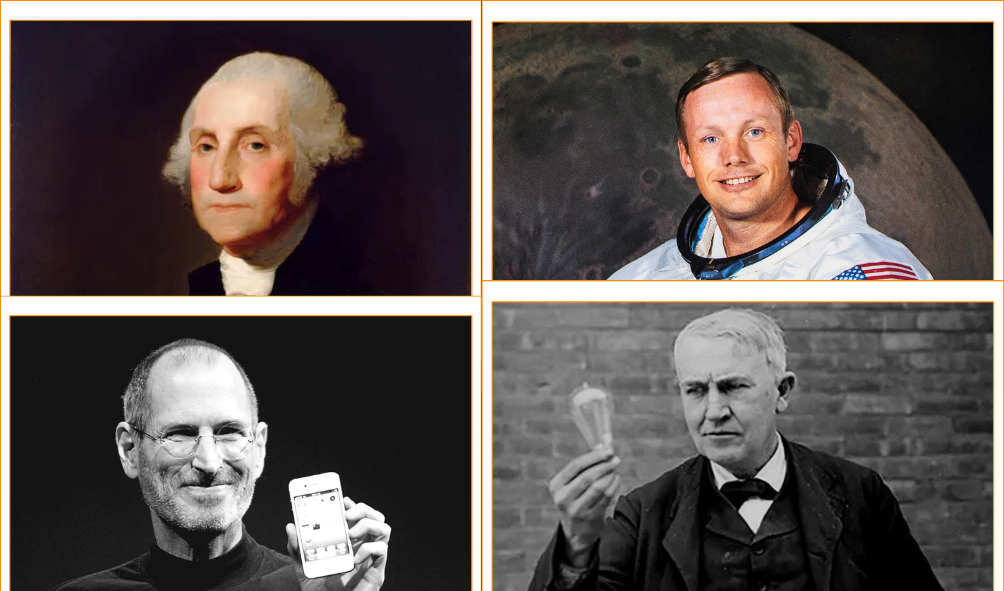
History turns on the actions of bold individuals. These American men, through grit and genius, reshaped nations, ignited innovations, and sparked movements. George Washington forged a republic from revolution. Neil Armstrong stepped onto the moon, proving human limits expandable. Their legacies echo in politics, science, rights, tech, sports, and culture. This founder of the U.S. set precedents still guiding leaders today. That astronaut’s footprint remains a symbol of ambition. Icons like Thomas Edison with his electric breakthroughs, Steve Jobs revolutionizing gadgets, Martin Luther King Jr. championing equality, Muhammad Ali blending fists with justice, and Walt Disney animating dreams continue inspiring billions. Which one fires you up most?
Who Was George Washington: Father of a Nation?
Picture a weary general crossing the Delaware River on Christmas night 1776. George Washington did just that, launching a surprise attack that revived the faltering American Revolution. This farmer-turned-leader commanded ragtag troops against Britain’s empire, securing independence by 1783.
Washington’s genius shone brightest post-victory. He presided over the 1787 Constitutional Convention, then served two terms as first U.S. president (1789-1797). He established the cabinet, stayed neutral in foreign wars, and warned against factions in his Farewell Address. Statistics underline his impact: under him, the U.S. population grew from 4 million to over 5 million, per U.S. Census records, laying economic foundations.
-
Key precedents he set: peaceful power transitions and federal authority over states.
-
Anecdote: He freed his slaves in his will, a bold move for his era, influencing abolition debates.
Historians credit him with preventing monarchy, as James Madison noted. His stoic leadership birthed democracy’s model.
What Made Neil Armstrong the Moon Man?
On July 20, 1969, Neil Armstrong uttered words etched in eternity: “That’s one small step for man, one giant leap for mankind.” As Apollo 11 commander, he became the first human on the lunar surface, watched by 650 million TV viewers worldwide, per NASA data.
This test pilot logged 18 Apollo hours, but his moonwalk capped the Space Race. NASA’s $25 billion program (1961-1972) employed 400,000, yielding tech like microchips now in your phone. Armstrong’s calm under 110-hour training pressure exemplified precision.
An anecdote reveals his humility: post-mission, he taught engineering at Purdue, shunning fame. He later captained the Enterprise shuttle simulator. His feat boosted U.S. prestige amid Cold War tensions, with moon rocks still studied for science.
Thomas Edison: How One Man Lit Up the World?
Thomas Edison, the “Wizard of Menlo Park,” held 1,093 U.S. patents, transforming darkness into daylight. In 1879, he perfected the practical incandescent bulb after 1,000 tries, as his notebooks show. This sparked the electric age; by 1900, U.S. homes with electricity jumped from 1% to 20%, per Energy Department stats.
He built the first industrial lab, birthing the phonograph (1877) and motion pictures. Edison’s rivalry with Tesla over AC/DC current electrified innovation debates. An early quip: “Genius is 1% inspiration, 99% perspiration.”
-
Breakthroughs: Alkaline battery, cement production.
-
Global reach: His companies merged into General Electric, a $150 billion firm today.
Edison’s tinkering mindset fuels modern inventors.
Steve Jobs: Who Revolutionized Personal Tech?
Steve Jobs co-founded Apple in 1976, but his 1984 Macintosh debut made computers intimate. “You’ll see why 1984 won’t be like ‘1984,’” he promised, selling 250,000 units Day 1. By 2011, iPhones dominated 50% of U.S. smartphones, per Statista.
Exiled then returning, he launched Pixar (Toy Story grossed $373 million) and iPods. His Stanford speech anecdote: “Stay hungry, stay foolish.” Jobs blended design with tech, creating trillion-dollar ecosystems.
Martin Luther King Jr.: The Voice of Civil Rights?
Martin Luther King Jr. dreamed aloud in 1963 before 250,000: “I have a dream.” This Baptist led the Montgomery Bus Boycott (1955-1956), slashing segregation after Rosa Parks’ arrest. The 1964 Civil Rights Act followed, banning discrimination.
King organized 1963 March on Washington; his nonviolence drew 1964 Nobel Peace Prize. FBI files note 60 million miles traveled. Assassinated 1968, his work cut U.S. poverty 10% for Black families by 1970s, Census data shows.
Muhammad Ali: Boxer Who Fought Beyond the Ring?
Muhammad Ali floated like a butterfly, stung like a bee. This heavyweight refused Vietnam draft 1967, saying, “I ain’t got no quarrel with them Viet Cong.” Stripped of title, he won it thrice, including 1974 “Rumble in the Jungle.”
Ali’s activism bridged sports and rights; Parkinson’s hit post-1981, yet he lit Olympic flame 1996. Stats: 56-5 record, inspired global anti-war sentiment.
Walt Disney: Animator Who Built Dream Worlds?
Walt Disney faced bankruptcy in 1923, losing Oswald the Rabbit to a studio. Undeterred, he sketched Mickey Mouse on a train ride, debuting Steamboat Willie in 1928—the first cartoon with synchronized sound. That mouse spawned a media juggernaut.
Snow White and the Seven Dwarfs (1937), the first full-color feature, risked everything and earned $418 million adjusted. Disneyland opened 1955 in Anaheim, drawing 20 million visitors Year 1 despite floods and breakdowns. By his 1966 death, Disney’s empire included TV’s Mickey Mouse Club (40 million weekly viewers).
-
Innovations: Multiplane camera for depth; theme parks blending story with immersion.
-
Fun fact: He won 22 Oscars, more than anyone.
Disney taught generations that imagination builds empires.
Why Do Their Legacies Still Matter Today?
These men didn’t just act; they redefined possible. Washington’s republic endures 235 years later. Armstrong’s moonshot seeded SpaceX’s Mars dreams—NASA’s Artemis echoes it. Edison’s grid powers 85% of U.S. homes (EIA stats). Jobs’ touchscreens dominate; King’s words fuel Black Lives Matter. Ali’s defiance inspires athletes like Colin Kaepernick; Disney’s stories stream on 1.5 billion devices via Disney+.
Stats tell the tale: U.S. GDP per capita tripled since Edison’s bulb (World Bank). Civil rights laws halved racial wealth gaps since King (Fed Reserve). Their stories prove one person’s stand ripples globally.
Which Historical Figure Inspires You Most?
From Washington’s resolve to Disney’s whimsy, these icons lit paths we walk. George? For steady leadership. Ali? For unbowed conviction. Who stirs your soul? Drop a comment—which one’s story pushes you to act?
Also Read | World’s Most Expensive Bridges: $20B Marvels That Changed History

