




Perimenopause is the hormonal transition leading up to menopause, and it can start as early as your mid-30s or as late as your mid-50s. This perimenopause symptoms checklist walks through the most common physical, emotional, and cognitive changes women report, what’s considered typical, and when a symptom warrants a call to your doctor.
If your periods have started arriving early, late, heavier, or not at all, and you’ve also noticed new sleep trouble, mood swings, or hot flashes, you may be wondering whether this is just a busy season of life or something more. For most women in their 40s (and some in their 30s or 50s), it’s perimenopause: the transitional stage when the ovaries gradually produce less estrogen before periods stop altogether as the body prepares to stop having periods, with women starting perimenopause at different ages, noticing signs such as irregular periods sometime in their 40s, though some notice changes as early as their 30s or as late as their 50s.
This perimenopause symptoms checklist is designed to help you recognize what’s happening in your body, track changes with confidence, and know when it’s time to loop in a healthcare provider. You’ll learn what perimenopause is, how long it typically lasts, the full range of symptoms women report, lifestyle strategies that can help, and the medical treatment options worth discussing with your doctor.

What Is Perimenopause?
Perimenopause sometimes called the menopausal transition, is the span of time before menopause when hormone levels, particularly estrogen, begin to rise and fall unpredictably as estrogen, the main female hormone in the body, rises and falls, periods may get longer or shorter, and ovulation may be skipped. It ends once a woman has gone 12 months in a row without a menstrual period, at which point she has reached menopause.
Perimenopause is not a disease. It’s a normal, natural stage of reproductive aging, but the hormonal swings involved can produce a wide range of physical and emotional symptoms, some of which are easy to miss or misattribute to stress, aging, or an unrelated health issue.
When Does Perimenopause Start? (Age and Timeline)
There’s no single age at which perimenopause begins, which is part of why it can be confusing to identify.
- Perimenopause may begin as early as your mid-30s or as late as your mid-50s, and some people are in this stage for only a short time while others experience it for several years.
- Research by Cleveland Clinic notes that the median age perimenopause begins is around 47, with the normal range spanning the mid-30s to the early-50s, based on longitudinal hormone studies.
- On average, perimenopause can start as early as a decade before menopause, though the typical length is about four years, and the SWAN (Study of Women’s Health Across the Nation) research shows the transition typically lasts 4 to 8 years, though it can be as brief as 2 years or extend beyond 8.
- Menopause itself, defined as 12 consecutive months without a period happens around age 52 on average in the United States.
If your periods change noticeably before age 40, that’s not typical perimenopause timing and deserves a conversation with your doctor, since it could point to primary ovarian insufficiency rather than a standard transition “if you’re in your early 40s or younger and you’re having symptoms of perimenopause, like skipping periods, you definitely need to bring that up to your doctor,” according to Cleveland Clinic menopause specialist Dr. Pelin Batur.
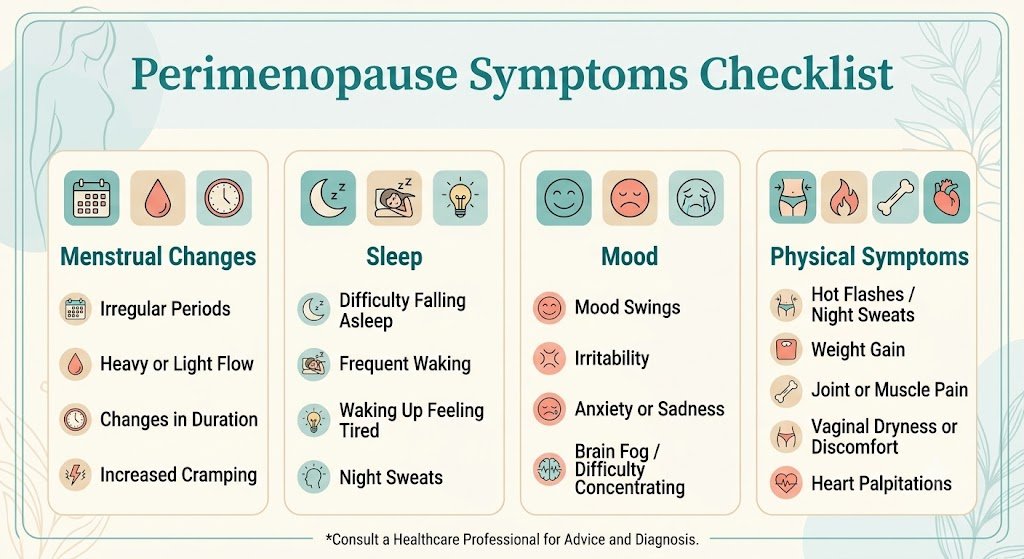
The Complete Perimenopause Symptoms Checklist
Not every woman experiences every symptom, and severity varies widely from person to person. Use this checklist to track what’s changing for you, it can be genuinely useful to bring notes like this to a medical appointment.
Menstrual Cycle Changes
- Periods arriving closer together or further apart
- Heavier or lighter bleeding than usual
- Skipped periods
- Longer or shorter cycles overall
Vasomotor Symptoms
- Hot flashes (sudden warmth, flushing, or sweating, often in the face, neck, and chest)
- Night sweats that interrupt sleep
Sleep and Energy
- Difficulty falling or staying asleep
- Fatigue or persistent low energy
- Waking unusually early
Mood and Cognitive Changes
- Irritability
- Anxiety or panic-like feelings
- Low mood or tearfulness
- Trouble concentrating (“brain fog”)
- Memory lapses
A 2024 clinical study of perimenopausal and menopausal women found cognitive and mood symptoms were reported even more frequently than hot flashes: the five most common complaints were feeling tired or lacking energy (96%), memory problems (93%), difficulty concentrating (91%), irritability (90%), and feeling tense or nervous (90%), with hot flashes and night sweats ranking lower on the list. This suggests mood and cognitive changes deserve just as much attention as the more commonly discussed hot flash.
Physical and Sexual Health
- Vaginal dryness or discomfort during sex
- Reduced libido
- Breast tenderness
- Joint or muscle aches
- Headaches, including new or worsening migraines
- Changes in skin or hair, including increased facial hair or hair thinning
- Weight changes, particularly around the abdomen
Clinical trial documentation summarizes the range this way: perimenopause symptoms include mood changes, anxiety, sleep disruptions, hot flushes, night sweats, fatigue, and cognitive challenges, along with irregular periods, decreased libido, vaginal dryness, memory and concentration problems, joint and muscle aches, headaches, and changes in skin or hair.
Symptoms in Your 40s vs. Your 50s
| Life Stage | Typically First Noticed | Common Focus |
|---|---|---|
| Early-to-mid 40s | Cycle irregularity, breast tenderness, mood changes, sleep disruption | Tracking cycle changes, ruling out other causes |
| Late 40s to early 50s | More frequent hot flashes/night sweats, vaginal dryness, joint aches, brain fog | Symptom management, discussing treatment options |
| Around 50–52 | Longer gaps between periods, symptoms may intensify before easing after the final period | Preparing for the menopause transition and postmenopause |
Myths vs. Facts
| Myth | Fact |
|---|---|
| “You’ll know it’s perimenopause because of hot flashes.” | Mood and cognitive symptoms fatigue, memory issues, irritability, are reported even more often than hot flashes in some studies (96% fatigue, 93% memory problems, versus hot flushes ranked 18th). |
| “Perimenopause only happens in your late 40s.” | It can begin as early as your mid-30s or as late as your mid-50s. |
| “Blood tests will confirm perimenopause.” | Blood work usually isn’t necessary, and hormonal fluctuations during perimenopause can make test results misleading; diagnosis is typically based on symptoms and menstrual history. |
| “HRT is too risky to consider.” | Older concerns stemmed largely from the Women’s Health Initiative study, which is now considered flawed in key respects, since many participants were more than a decade past menopause, a group for whom HRT is no longer recommended. Current guidance emphasizes individualized risk-benefit discussions with a clinician. |
| “You just have to push through the symptoms.” | “Just grin and bear it” isn’t a solution, according to Cleveland Clinic’s Dr. Batur, effective treatment options exist. |
Lifestyle Strategies That May Help
While lifestyle changes won’t stop the hormonal shifts of perimenopause, several habits are commonly recommended to ease symptoms:
- Regular exercise — supports mood, sleep, bone density, and weight management. Eating a balanced diet and exercising regularly can go a long way toward easing most perimenopausal symptoms, according to Mayo Clinic.
- Balanced nutrition — an emphasis on whole foods, calcium, and vitamin D supports bone health during a time when estrogen (which helps protect bone density) is declining.
- Consistent sleep habits — a cool bedroom, regular sleep-wake times, and limiting alcohol or caffeine close to bedtime can reduce night sweat disruption.
- Stress management — mindfulness, therapy, or support groups can help with the mood symptoms that are often just as disruptive as physical ones.
- Tracking your symptoms — Mayo Clinic recommends women write down symptoms specifically, note whether they relate to the menstrual cycle, record major stresses or life changes, and list all medications, herbs, vitamins, and supplements being taken ahead of a doctor’s visit.
A note on supplements: Some women turn to nutraceuticals such as black cohosh, vitex, or ashwagandha. Roughly 80% of women in one observational cohort reported using supplements for perimenopause symptoms, but evidence for these products is generally less robust than for hormone therapy, and quality/dosing varies by brand. Talk to your doctor before starting any supplement, especially if you take other medications.
Medical Treatment Options
Hormone replacement therapy (HRT) remains the most extensively studied and effective medical treatment for perimenopausal symptoms.
- HRT works by replacing hormones, usually estrogen, and progesterone if you still have a uterus, that are declining, and using the right type and dose usually leads to improvement in symptoms.
- Hot flushes and night sweats often improve within a few weeks of starting HRT, while mood changes and vaginal dryness can take a few months to improve.
- You do not need to wait until periods stop completely to start treatment: HRT can usually begin as soon as symptoms become bothersome, rather than after periods have fully stopped.
- The risks of HRT are generally small and are usually outweighed by the benefits for most people, though your doctor will review your individual risk factors, including history of blood clots, stroke, or certain cancers.
- Non-hormonal options exist for women who cannot or prefer not to use HRT, including certain medications targeted at hot flashes; your doctor can walk through what’s appropriate for your health history.
This is a genuinely individualized decision. Evidence on the balance of risks and benefits has evolved over the past two decades, and current medical consensus supports discussing HRT, including its timing relative to your final period, directly with a clinician familiar with your health history, rather than ruling it out based on outdated information.
When to See a Doctor
Reach out to a healthcare provider if you notice:
- Menstrual changes before age 40–45 (which may signal primary ovarian insufficiency rather than typical perimenopause)
- Very heavy bleeding, bleeding between periods, or bleeding after sex
- Symptoms that are significantly disrupting your sleep, work, or relationships
- New or worsening anxiety, depression, or panic symptoms, research has found women are two to four times more likely to experience a major depressive episode during perimenopause than before it.
- Painful sex or vaginal dryness affecting your quality of life
- Any symptom you’re unsure about, as Cleveland Clinic puts it, “just grin and bear it” isn’t a solution, and a menopause-literate provider can help you find the right approach.
Common Mistakes Women Make
- Assuming it’s “just stress” or “just aging.” Mood, sleep, and cognitive symptoms are frequently misattributed to other causes, delaying helpful treatment.
- Waiting until periods stop completely to seek treatment. Symptom relief, including HRT, can often start earlier, as soon as symptoms become bothersome.
- Relying solely on a blood test for diagnosis. Hormone fluctuations during perimenopause can make blood work misleading, so symptom tracking and menstrual history matter more.
- Ruling out HRT based on decades-old research. Current expert discussion distinguishes today’s individualized, risk-stratified approach from the older Women’s Health Initiative findings, now viewed as flawed for the broader population of newly perimenopausal women.
- Not tracking symptoms before an appointment. A written symptom log makes it far easier for a provider to help.
Expert Tips
- Keep a simple daily or weekly log of symptoms, noting their relationship to your cycle.
- Bring a list of all medications, supplements, and vitamins to every appointment.
- Seek out a provider with specific menopause training if your current doctor feels unfamiliar with the topic, dedicated menopause clinics and certified menopause practitioners exist in many regions.
- Don’t wait for symptoms to become severe before asking for help.
- Lean on your support network. It’s not uncommon to feel insecure or isolated during this transition — support from family, friends, and community groups can help.
Frequently Asked Questions
What is the first sign of perimenopause?
For most women, the earliest and most common sign is a change in the menstrual cycle, periods becoming irregular, heavier, lighter, or further apart.
How long does perimenopause last?
It varies significantly. On average it lasts around four to five years from the first hot flush, though the full transition typically spans 4 to 8 years and can extend beyond that for some women.
Can perimenopause start in your 30s?
Yes, though it’s less common. Perimenopause can begin as early as the mid-30s. If symptoms appear before 40, it’s worth discussing with a doctor to rule out primary ovarian insufficiency.
Do I need a blood test to confirm perimenopause?
Usually not. Because hormone levels fluctuate so much during this stage, blood tests can be misleading, and diagnosis is typically based on symptoms and menstrual history.
Is hormone therapy safe?
For many women, yes, current guidance suggests the risks of HRT are generally small and outweighed by the benefits, though it should always be an individualized decision made with your doctor based on your personal health history.
Are mood swings really part of perimenopause, or is it just life stress?
Mood changes are a well-documented part of perimenopause. Studies show irritability and feeling tense or nervous are among the most commonly reported symptoms, and women face a meaningfully higher risk of major depressive episodes during this transition. If mood changes are significant, that’s a valid reason to see a doctor, not something to dismiss as “just stress.”
Key Takeaways
- Perimenopause is the natural hormonal transition before menopause and can begin anywhere from the mid-30s to mid-50s.
- Symptoms go well beyond hot flashes, cycle changes, mood shifts, sleep trouble, and cognitive changes are all common and, in some studies, more frequently reported than hot flashes.
- Diagnosis is based mainly on symptoms and menstrual history, not blood tests.
- Effective treatments exist, including HRT and non-hormonal options, you don’t have to “just live with it.”
- Track your symptoms and see a doctor if changes start before 40, are severe, or are affecting your daily life.
Conclusion
Perimenopause looks different for every woman, but the hormonal shifts behind it are universal. Using a structured perimenopause symptoms checklist, for your cycle, your sleep, your mood, and your physical health, can help you separate typical transition symptoms from something that needs medical attention, and it gives your doctor a clearer picture to work from. You don’t have to figure this out alone, and effective, evidence-based treatment options are available.
Also Read | New Knee Osteoarthritis Treatment Could Be Covered by Insurance

