



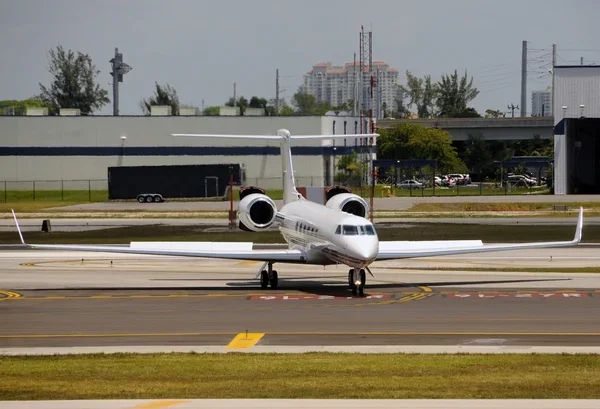
On November 1, 2026, a Learjet 60 carrying nine people plunged from 35,000 feet and crashed into a residential neighborhood in Greenacres, Florida. Before the aircraft entered its final, uncontrolled dive, the crew reported a detail that aviation investigators are now examining closely: ice. “We have light, clear ice that is manageable and moderate turbulence,” the co-pilot told air traffic control, shortly before requesting clearance to climb. Within 30 seconds of that request, the jet was descending at rates that would eventually exceed 32,000 feet per minute. Everyone on board was killed. While the National Transportation Safety Board has not determined the cause of the crash, icing has emerged as a central focus of the investigation. Aviation experts, including a former air safety investigator and a former U.S. Navy TOPGUN fighter pilot, have publicly offered analyses of how ice accumulation on the aircraft’s surfaces could have triggered a catastrophic and unrecoverable loss of control. This article explains how ice forms on aircraft in flight, what it does to aerodynamic performance, why the Learjet 60’s design may have made it particularly vulnerable, and what investigators are looking for in the wreckage.

| Florida Learjet Crash: Quick-Reference Facts | |
|---|---|
| Aircraft | Bombardier Learjet 60 (2004 model) |
| Registration | N722BD |
| Operator | Aurora Aviation, d/b/a Upper Jets (Part 135) |
| Departure | Austin-Bergstrom International Airport, Texas |
| Destination | North Eleuthera Airport, Bahamas |
| Date of Crash | November 1, 2026 |
| Time of Crash | Approx. 12:50 p.m. ET |
| Crash Location | Greenacres, Palm Beach County, Florida |
| Victims | All 9 aboard killed (7 passengers, 2 crew) |
| Pilot-in-Command | Jeff Gregory, 55 |
| Co-Pilot | Nathalia Gadelha Filgueiras, 20 |
| Reported Weather | Light clear ice, moderate turbulence, minus 47 C |
| Maximum Descent Rate | Exceeding 32,000 ft/min (Flightradar24 data) |
| Lead Investigator | NTSB, with FAA support |
How Ice Forms on Aircraft at High Altitude
Ice does not form on an aircraft simply because the air is cold. It requires two conditions occurring simultaneously: the presence of visible moisture, typically in the form of cloud droplets or precipitation, and an air temperature at or below 0 degrees Celsius (32 degrees Fahrenheit). When supercooled water droplets, liquid water that has cooled below freezing without turning to ice, strike an aircraft’s surfaces, they freeze on contact.
At 35,000 feet, where the Learjet 60 was flying when the crew first reported icing, the outside air temperature was approximately minus 47 degrees Celsius. This is cold enough that most moisture in the atmosphere has already frozen into ice crystals, which typically bounce off aircraft surfaces rather than adhering. But in and around cumuliform clouds, particularly near the tops of developing thunderstorms, pockets of supercooled liquid water can persist even at extreme altitudes. Meteorologist Matthew Cappucci of MyRadar identified a developing thunderstorm near the Learjet’s route at the time of the incident, estimating that the storm top rose from under 33,000 feet at 12:36 p.m. to approximately 48,300 feet by 12:56 p.m. The aircraft was flying through a rapidly evolving weather environment.
There are several types of ice that can form on an aircraft, and each presents different hazards:
Clear ice forms when larger supercooled droplets, common in freezing rain or near cumuliform clouds, flow across the aircraft surface before freezing. The result is a dense, smooth, glossy layer that conforms closely to the shape of the surface, making it difficult to detect visually and harder to remove. Clear ice is considered the most dangerous type because of its weight and its ability to alter aerodynamic surfaces far aft of the leading edge.
Rime ice forms when small droplets freeze almost instantly on contact, trapping tiny air pockets. It appears white and opaque, is typically lighter than clear ice, and tends to collect on leading edges. It generally forms in stratiform clouds at temperatures between minus 10 and minus 20 degrees Celsius.
Mixed ice combines characteristics of both clear and rime ice, producing an irregular, lumpy accretion that is especially difficult for de-icing systems to manage.
The crew of the Learjet 60 specifically reported “light, clear ice,” indicating that the type of ice accumulating was the dense, translucent variety that experts consider most hazardous.
What Ice Does to a Wing and Why It Causes Stalls
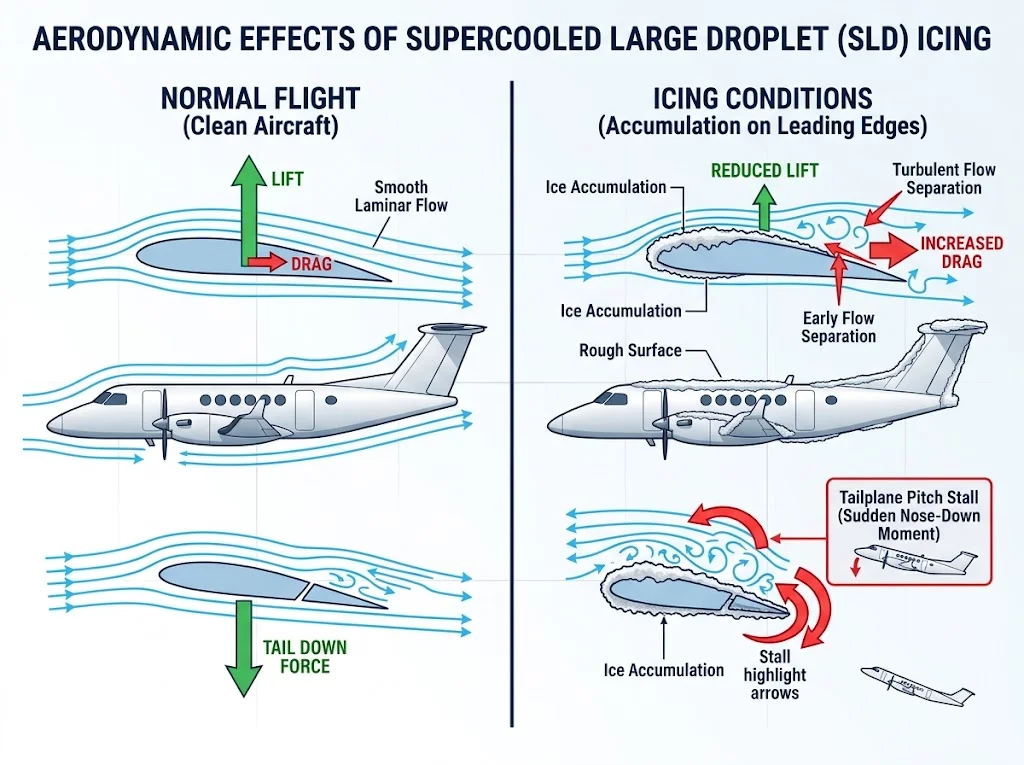
An aircraft’s wing generates lift because of its shape. The curved upper surface accelerates airflow, creating lower pressure above the wing than below it. This pressure difference produces the upward force that keeps the aircraft airborne. Anything that disrupts the smooth flow of air over the wing reduces its ability to generate lift and increases aerodynamic drag.
Ice does both. According to the FAA’s Advisory Circular on Flight in Icing Conditions (AC 91-74B), ice on a wing’s leading edge “significantly reduces” the maximum coefficient of lift, the measure of how much lift a wing can produce at a given angle of attack and airspeed. At the same time, ice increases drag. The Pilot Institute reports that drag can rise by up to 50 percent from ice on the leading edge and upper wing surface, and by 100 percent or more with thick or irregular buildup. Scientific American has noted that even “sandpaper roughness” from a thin layer of ice can meaningfully alter the stall point.
The practical effect is that an iced wing stalls at a lower angle of attack and at a higher airspeed than a clean wing. In other words, an aircraft that was flying safely within its performance envelope can suddenly find itself beyond its aerodynamic limits without the pilot changing anything. If the crew is unaware of the extent of ice accumulation, particularly if the autopilot is masking the increasing control forces needed to maintain altitude, the first sign of trouble may be the stall itself.
The FAA and the NTSB have both cautioned that autopilot use in icing conditions can be dangerous. An autopilot compensates for degrading aerodynamic performance by gradually applying more control input, effectively hiding the symptoms from the flight crew. When the autopilot reaches its authority limits and disconnects, the aircraft may be much closer to a stall than the pilots realized. Scientific American reported that icing has been a contributing factor in 9.5 percent of fatal scheduled air carrier accidents.
The Tailplane Stall Theory: A Nose-Down Pitch That Cannot Be Recovered
While wing icing gets the most public attention, several experts have pointed to a different and potentially more dangerous phenomenon as a possible factor in the Learjet crash: a tailplane stall.
Dan Diggins, a former air safety investigator and veteran pilot, told MySunCoast that ice on the horizontal stabilizer, the small wing at the tail of the aircraft, may have caused a sudden, violent nose-down pitch from which recovery was essentially impossible. The horizontal stabilizer produces a downward force that balances the aircraft’s natural tendency to pitch nose-down. If ice accumulates on the stabilizer and disrupts its aerodynamic performance, it can stall, just as a main wing stalls. But the consequences are opposite: instead of the nose pitching up (as in a wing stall), the nose pitches sharply down.
Diggins explained that several factors make tailplane stalls particularly lethal. First, there is typically no ice-detection system or stall warning for the horizontal stabilizer. Pilots may not know ice is accumulating on the tail. Second, the correct recovery procedure is the opposite of what pilots are trained to do for a wing stall. A wing stall requires the pilot to push the nose down to reduce the angle of attack. A tailplane stall requires the pilot to pull back. Flying Magazine has noted that the controls can be “snatched from your hands” during a tailplane stall and that recovery “often takes enormous back pressure, sometimes with the copilot helping.” Third, tailplane stalls cannot be safely simulated in real aircraft for training purposes, meaning most pilots have never experienced one and may not recognize it.
Diggins suggested that ice built up on the Learjet’s tail before the crew attempted to climb from 35,000 to 37,000 feet. The power change and pitch adjustment associated with the climb may have pushed the iced stabilizer past its critical angle of attack, triggering an abrupt stall. He estimated the pilots had under 10 seconds to react and virtually no chance to recover.
Coffin Corner and the Learjet 60’s Vulnerability at Altitude
The circumstances of the crash also bring into play a well-known aerodynamic hazard called “coffin corner,” a phenomenon that occurs at high altitudes where the margin between stalling and exceeding the aircraft’s maximum operating speed becomes dangerously narrow.
At higher altitudes, where the air is thinner, an aircraft must fly faster to generate the same amount of lift. This means the stall speed, the minimum speed at which the aircraft can maintain flight, increases as the aircraft climbs. At the same time, the aircraft’s maximum operating speed, limited by structural and aerodynamic constraints, remains essentially fixed. At a high enough altitude, these two limits converge. The aircraft is flying in a narrow speed band where slowing down by even a few knots could trigger a stall, while speeding up by a few knots could cause structural failure or loss of control from compressibility effects.
For the Learjet 60, which has a maximum operating speed of Mach 0.81, this convergence becomes a factor at the altitudes at which the crew was flying. Matthew “Whiz” Buckley, a former U.S. Navy TOPGUN Adversary pilot who flew F/A-18 Hornets, analyzed the crash for CBS Austin and made a blunt assessment of the Learjet’s design. “Learjet did not design that wing for even a little bit of ice buildup,” Buckley said. He explained that ice further narrows the already tight speed margin by raising the stall speed. When the aircraft attempted to climb and ice simultaneously degraded lift, it may have entered a state where maintaining controlled flight was aerodynamically impossible. Buckley described the result in plain terms: the aircraft “just turns into a brick.”
Buckley also pointed to crash video analysis, noting that frames captured just before impact appeared to show the jet missing its horizontal stabilizer. He suggested that at the speeds reached during the dive, which likely far exceeded the aircraft’s structural design limits, “it’s not gonna take a lot to snap a horizontal stab off a Learjet.” These are corporate jets, he emphasized, not fighter aircraft, and they are not built to withstand the forces generated by a Mach-speed dive.
The ATC Timeline: 35 Seconds from Climb Request to Final Transmission
The air traffic control recordings from the Learjet’s final minutes provide a compressed timeline of how quickly the situation deteriorated.
At approximately 12:47 p.m. Eastern Time, the crew reported their conditions at 35,000 feet: light, clear ice described as manageable, moderate turbulence, and an outside air temperature of approximately minus 47 degrees Celsius. The turbulence was causing altitude deviations of roughly 700 feet. The crew requested clearance to climb to 37,000 feet. Controllers approved.
Less than 30 seconds later, the aircraft was no longer climbing. The crew declared an emergency, then a mayday. The pilot reported an overspeed condition and a descent rate of 8,000 feet per minute. The rate rapidly escalated: 10,000, then 20,000, then 22,000 feet per minute. Flightradar24 flight-tracking data later indicated the descent may have peaked beyond 32,000 feet per minute.
A female voice, believed to be co-pilot Nathalia Filgueiras, said, “We’re going to crash into the ground.” A male voice said, “We’re out of time.” The last received altitude was 8,750 feet at 12:49:22 p.m. The crash occurred approximately one minute later.
The entire sequence, from the initial climb request to the loss of all communication, lasted approximately 35 seconds. DeWitt Ingram, a Learjet-qualified captain, told CBS12 that rough air near the top of a developing storm could damage the aircraft and cause a total loss of control, and that once an uncontrolled descent began at those speeds, the aerodynamic and structural forces would likely exceed anything the pilots could recover from.
✈️ Crash at Miami, Florida of USA.
THE FINAL 52 SECONDS — WHEN EVERY SECOND BECOMES A FIGHT FOR LIFE.( ATC & Pilot communication of live atc version not CVR version listen below Audio file such a tragic 52 second 👇).
1) Pilot Reported Altitude 35000 feet , moderate Turbulence , Outside Temperature – 47°C & Requested Climb to 37000 feet due to Rain in such altitude.
2) During Climb Aircraft malfunction ,it appears Aircraft enter severe weather areas within seconds loss of control followed by Aircraft gone into dive 10000 to 20000 FPM dive , Over speed,more than 60 Degree Bank angle & tragic end.For millions who travel by air,
the Cockpit is a place of trust, professionalism and absolute responsibility. But sometimes, even the most experienced Pilots face moments when nature turns against every human effort.
Listen to these final radio exchanges between the female pilot of the doomed Learjet 60 and Miami ATC. What begins as routine communication gradually turns into an increasingly desperate struggle against an unfolding catastrophe. Her voice, the urgency( MAY DAY SOS) in her calls and the final moments of communication ” We are running out of Time , Look outside instruction to Senior Pilot” leave a haunting impression.Nine souls on board. A routine flight turned into a nightmare. Fifty-two seconds of audio that remind us how fragile human life can be at 35,000 feet.
Every passenger who boards an aircraft deserves to return home safely. Every pilot fights for that promise.
May the nine departed souls rest in eternal peace. 🕯️
#AviationSafety #FinalTransmission #Learjet60 #AviationHistory #Mayday #FlightSafety— Capt. B. Parthosarothy (@pilotpartho) November 2, 2026
Historical Precedent: Icing-Related Crashes the NTSB Has Investigated
The crash in Greenacres is far from the first time icing has been implicated in a catastrophic aviation accident. Several landmark investigations have shaped current understanding of the threat.
On October 31, 1994, American Eagle Flight 4184, an ATR 72 turboprop, crashed near Roselawn, Indiana, killing all 68 people aboard. The NTSB determined that supercooled large droplets caused a ridge of ice to form behind the de-icing boots on the wings, leading to a sudden uncommanded roll and loss of control. The accident led to significant changes in FAA certification requirements for flight in icing conditions.
On February 12, 2009, Colgan Air Flight 3407, a Bombardier Dash 8 Q400, crashed near Buffalo, New York, killing 49 people aboard and one person on the ground. The crew had been flying in icing conditions with the autopilot engaged. When the stick shaker activated warning of an impending stall, the captain pulled back on the controls instead of pushing forward, an incorrect response that made the stall unrecoverable. The NTSB cited the captain’s inappropriate response to the stall warning as the probable cause but noted that icing had degraded the aircraft’s performance and that the autopilot had masked the degradation. The crash led to sweeping changes in pilot training, rest requirements, and qualifications.
In 2022, a Beechcraft King Air 90 crash was attributed to a tailplane stall caused by structural icing, underscoring that the tailplane icing hazard remains present in modern operations despite decades of warnings.
These accidents demonstrate a recurring pattern: ice degrades performance gradually, the degradation is not always visible to the crew, and when the aircraft reaches its limits, the onset of the emergency is sudden and the time available for recovery is measured in seconds.
What the NTSB Investigation Will Look For
The NTSB’s investigation into the Learjet 60 crash is expected to take 12 to 18 months before a final probable cause determination. Approximately 20 investigators have been assigned to the case, and NTSB member Tom Chapman has confirmed that weather, including icing, is a primary focus.
Several specific areas of inquiry are likely to determine the outcome:
The wreckage distribution across approximately 1.2 miles will be mapped to determine whether the aircraft broke apart in flight. Chapman has said there is “some indication that the aircraft was breaking up before impact,” which would be consistent with structural failure during the high-speed dive.
The cockpit voice recorder, if the aircraft was equipped with one and it survived the crash, would provide critical information about the crew’s actions and communications during the emergency. The NTSB has expressed uncertainty about whether the aircraft carried a CVR, as the Learjet 60 operating under Part 135 charter rules is not universally required to have one.
Maintenance records for the aircraft, including the condition and recent servicing of its ice protection systems, will be reviewed. The Learjet 60 uses bleed air from its Pratt and Whitney Canada PW305A turbofan engines to heat the wing leading edges and engine inlets, preventing ice from forming. If these systems were not functioning properly, ice could have accumulated more rapidly than the crew expected.
Weather data, including radar imagery, pilot reports from other aircraft in the area, and atmospheric modeling, will help determine the exact icing conditions the aircraft encountered. The crew described the ice as “light” and “manageable,” but conditions can change rapidly near developing thunderstorms.
Flight data, from whatever recording devices are recovered and from the Flightradar24 transponder track, will show the aircraft’s speed, altitude, vertical rate, and heading throughout the event, helping investigators reconstruct the aerodynamic sequence that led to the loss of control.
Frequently Asked Questions
How does ice cause a plane to crash?
Ice accumulates on an aircraft’s wings, tail surfaces, and engine inlets when supercooled water droplets in clouds freeze on contact. Ice disrupts the smooth airflow over these surfaces, reducing lift and increasing drag. According to the FAA, this “significantly reduces” the wing’s maximum lift capability. The aircraft can stall at a higher speed and lower angle of attack than normal, meaning it may lose lift suddenly without warning. If the stall occurs at an altitude or speed that prevents recovery, the result can be catastrophic.
What is a tailplane stall and could it have caused the Florida Learjet crash?
A tailplane stall occurs when ice on the horizontal stabilizer (the small wing at the tail) causes it to lose lift. Unlike a wing stall, which pitches the nose up, a tailplane stall pitches the nose sharply down. Former air safety investigator Dan Diggins told MySunCoast that this scenario is consistent with the Learjet’s behavior, noting that there is no ice detection or stall warning for the horizontal stabilizer and that the correct recovery procedure is the opposite of standard stall recovery. The NTSB has not confirmed this theory.
What is “coffin corner” and was the Learjet flying in it?
Coffin corner is the aerodynamic condition at high altitude where the margin between an aircraft’s stall speed and its maximum operating speed becomes dangerously narrow. At 35,000 feet, the Learjet 60 was operating in an environment where ice accumulation could raise the stall speed enough to close that margin entirely. Former TOPGUN pilot Matthew Buckley explained that the Learjet’s wing was “not designed for even a little bit of ice buildup” and that icing at that altitude could leave the aircraft with no safe speed to fly.
What type of ice was reported on the Florida Learjet before the crash?
The crew reported “light, clear ice” that they described as “manageable.” Clear ice forms when larger supercooled droplets flow across a surface before freezing, producing a dense, smooth, translucent layer. It is considered the most dangerous type of aircraft icing because of its weight, its tendency to form aft of de-icing equipment, and its difficulty to detect visually. Despite the crew’s characterization of it as manageable, conditions can change rapidly near developing thunderstorms.
Has icing caused other major aviation crashes?
Yes. Notable icing-related crashes include American Eagle Flight 4184 near Roselawn, Indiana (1994, 68 killed), caused by supercooled large droplets creating ice ridges behind de-icing boots; and Colgan Air Flight 3407 near Buffalo, New York (2009, 50 killed), where icing degraded performance and the autopilot masked the degradation until a stall warning fired. Scientific American has reported that icing has been a contributing factor in 9.5 percent of fatal scheduled air carrier accidents.
What de-icing systems does the Learjet 60 have?
The Learjet 60 uses engine bleed air to heat the wing leading edges and engine inlets, a thermal anti-icing system designed to prevent ice from forming on critical surfaces. However, former TOPGUN pilot Matthew Buckley has stated that the aircraft’s wing was not designed for significant ice accumulation, and former investigator Dan Diggins noted that there is no ice detection system for the horizontal stabilizer. If ice forms in areas not covered by the anti-icing system, or if conditions exceed the system’s capacity, the aircraft remains vulnerable.
Also Read | Who Is Keisha Lance Bottoms? Career and Historic Georgia Election Victory

