



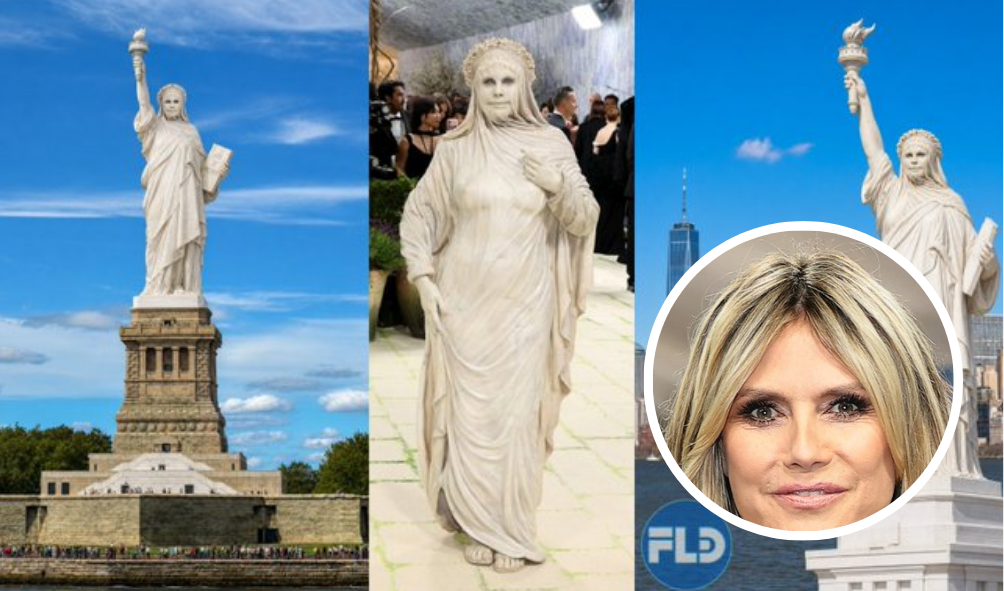
The reason this moment resonated is simple: Klum did not just wear an outfit, she performed an idea. At the 2026 Met Gala, she arrived in a sculptural, marble-inspired look by Mike Marino that transformed her into a living artwork, while her recent comments about menopause had already reframed how many people saw her body. In an industry that often sells youth as the default standard, that combination felt unusually direct and refreshingly human.

Heidi Klum’s Met Gala Look
Klum’s ensemble was built around the 2026 theme, “Costume Art,” which centered on the dressed body as a form of art and included the official dress code “Fashion Is Art”. Reports described her outfit as a latex-and-spandex creation designed to evoke carved stone, with references to classical sculptures such as the Veiled Christ and Veiled Vesta.
What made the look work was not just shock value, but alignment with the theme. The costume blurred fashion, sculpture, and performance in a way that fit the exhibition’s focus on bodies, representation, and the role of clothing in shaping how we understand art. In other words, the look answered the brief while still feeling unmistakably Heidi Klum.
The Menopause Conversation
Before the Met Gala, Klum had already sparked attention by speaking candidly about menopause and the physical changes that came with it, including weight gain. One widely circulated line from that conversation was her insistence that she was not pregnant, only experiencing a body change linked to menopause.
That honesty mattered because it challenged a familiar media habit: reading women’s bodies through suspicion, judgment, or impossible beauty standards. Klum’s comments made the issue feel less abstract and more relatable, especially for women in midlife who recognize the same changes in their own lives. The message was not that change is glamorous, but that it is normal.
Why It Landed
The timing amplified the impact. The Met Gala’s 2026 theme already centered the body as art, including categories that acknowledge aging, pregnancy, and other overlooked forms of embodiment. Against that backdrop, Klum’s candid menopause remarks and her statue-like entrance felt connected, almost like two chapters of the same argument about visibility.
This is where the story became larger than celebrity fashion. Research on menopause and body image has found that body dissatisfaction remains common in middle age, with studies showing persistent concerns among women during and after the menopausal transition. Klum’s openness gave that reality a recognizable face, which is one reason the moment traveled so widely online.
Heidi Klum at the Met Gala dressed as a slightly haunted Greek statue?
If a museum reported a missing exhibit tonight, the NYPD knows where to look… https://t.co/U3jUlsZF0Z pic.twitter.com/m1TVDbR999
— Mario Nawfal (@MarioNawfal) May 5, 2026
What It Says About Aging
Klum’s appearance also pushed back on the idea that women in their 50s should disappear from style conversations. She has previously said women over 50 are not “off the shelf,” and that mindset fits the broader response to her 2026 public image. Instead of treating aging as an end point, the reaction to her look suggested that confidence, visibility, and glamour can still coexist with change.
There is also a practical reason the conversation hit home. Menopause often brings changes in body composition, and research notes that women may gain around 1.5 pounds per year during midlife on average, while many report weight gain and shifts in abdominal fat distribution. That does not mean every woman will experience the same thing, but it does show why Klum’s remark connected with so many people.
Closing Angle
Klum’s 2026 Met Gala appearance worked because it united style, self-awareness, and timing. The result was a red carpet moment that felt less like a stunt and more like a cultural correction, especially for women who have been told their changing bodies should stay out of sight.
Also Read | Lauren Conrad Family: Inside Her Laguna Beach Parents & Siblings

