



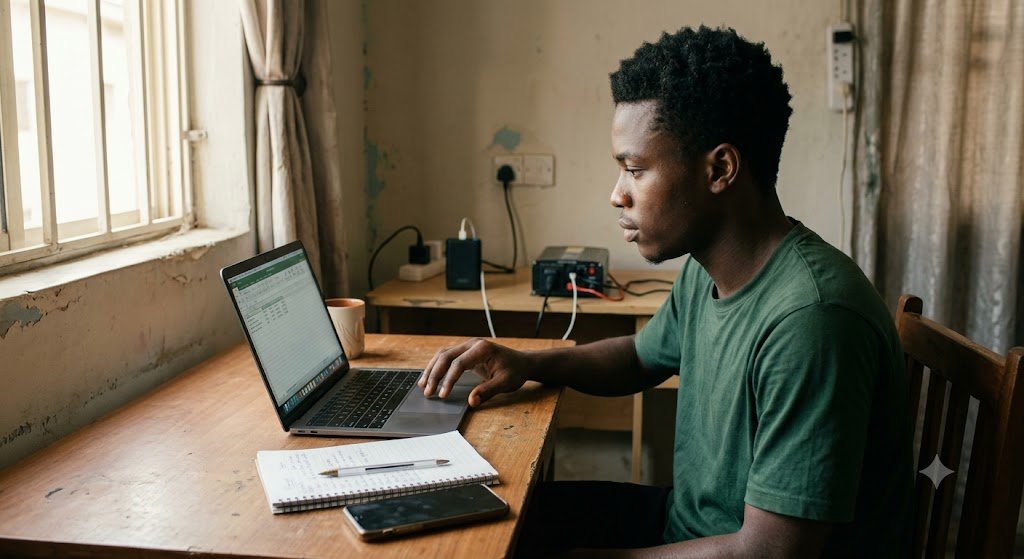
Somewhere in Nigeria tonight, a student will finish a client’s work on a phone with 40 percent battery, send it off over patchy data, and receive more for that single task than some office workers earn in a week. Somewhere else, another person with the same talent and the same phone will spend the evening scrolling posts about freelancing, convinced it requires experience, connections, or capital they do not have.
The difference between them is not talent. It is that one of them started.
Freelancing, selling your skills directly to clients, locally and worldwide, has become one of the most realistic income paths open to young Nigerians. It requires no certificate, no office, no employer’s permission, and no capital beyond a device and data. What it does require is a skill someone will pay for, proof that you have it, a way to be found, and a way to be paid, and every one of those four things can be built from zero. Thousands of Nigerians on platforms like Upwork and Fiverr, and in direct client relationships, prove it monthly.
This guide is the complete starting map: a seven-step system covering skill selection, building proof without clients, setting up winning profiles, finding your first freelance jobs, getting paid into a Nigerian account (the part most guides skip or get wrong), pricing, and growing. It is honest about the hard parts, the slow first weeks, the scams to avoid, the payment obstacles, because a guide that hides the obstacles just schedules your discouragement. Follow the steps in order, and “no experience” becomes a temporary condition rather than a permanent excuse.
What Freelancing Really Is (and Is Not)
Freelancing means selling a service, writing, design, admin support, coding, editing, marketing, directly to clients, per project or per hour, without being anyone’s employee. Your clients can be a business in Lagos, a startup in London, or a podcaster in Texas; the internet makes distance irrelevant.
Clear the myths first, because they stop more people than any real obstacle:
- It is not quick money. The first weeks are learning and outreach with little income. It is a small business, and businesses take time to open.
- It does not require a laptop on day one. Many Nigerian freelancers started on phones, in writing, virtual assistance, social media management, and transcription, and bought laptops from earnings.
- It does not require experience; it requires proof. Clients never ask how long you have worked. They ask to see what you can do, and proof can be manufactured before any client exists, as Step 3 shows.
- It is real work with real standards. Deadlines, revisions, and professional communication decide your reputation, and reputation decides everything after your first jobs.
Callout: The freelancer’s equation. Income = (a skill someone pays for) × (visible proof) × (consistent outreach) × (reliable delivery). Zero in any factor makes the total zero, which is why this guide builds all four.
Also Read | How Artificial Intelligence Is Transforming Education in 2026
Step 1: Get Your Foundation Right
Before skills and platforms, fix the basics that quietly disqualify beginners:
- A professional identity. A Gmail address built on your real name, a decent phone-camera headshot with a plain background, and a one-line description of what you do.
- Reliable-enough connectivity. You do not need perfect light and fibre; you need a plan: a power bank, knowledge of where you can work during outages, and data on two networks. Clients forgive Nigerians nothing less than missed deadlines, so redundancy is professionalism.
- A work rhythm. Decide your daily freelancing hours now; even two focused hours daily beats scattered bursts, because Steps 2 through 6 are built from those hours.
Step 2: Pick One Skill You Can Learn Free
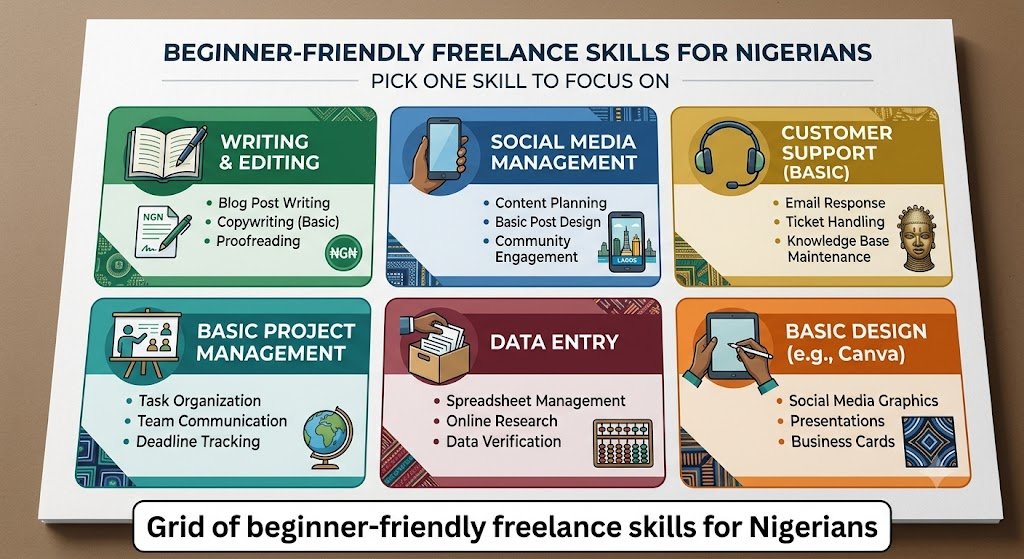
The most common beginner error is trying to offer everything. Clients hire specialists, and beginners become specialists by picking one skill and going deep for four to eight weeks. These are the most beginner-friendly, in rough order of learning speed:
| Skill | Learning time to sellable level | Device needed | Free learning sources |
|---|---|---|---|
| Virtual assistance (email, scheduling, research) | 2–4 weeks | Phone possible, laptop better | YouTube, ALX, Google’s free courses |
| Freelance writing (blogs, articles, product descriptions) | 4–6 weeks | Phone possible | YouTube, free writing blogs, practice |
| Social media management | 4–6 weeks | Phone sufficient | Meta Blueprint free courses, YouTube |
| Transcription and captioning | 2–4 weeks | Phone possible | Free practice files, YouTube |
| Graphic design (social graphics, flyers) | 6–8 weeks | Phone (Canva) to start | Canva tutorials, YouTube |
| Data entry and web research | 1–2 weeks | Laptop preferred | YouTube |
| Video editing (short-form) | 6–8 weeks | Good phone or laptop | CapCut tutorials, YouTube |
| Web development | 3–6 months | Laptop required | freeCodeCamp, YouTube, ALX |
How to choose: pick the intersection of what you can learn with your current device, what you find least painful to practice daily, and what businesses visibly pay for. Writing, virtual assistance, and social media management are the classic Nigerian starting trio because they monetize fastest on the least equipment. Web development pays most eventually but takes months; treat it as a second skill funded by a faster first one if money is urgent.
Then learn by doing, not just watching: for every hour of tutorials, spend an hour producing actual work, because that produced work becomes Step 3.
Step 3: Build Proof Without a Single Client
“No experience” is solved here, in one to two weeks, using three legitimate methods:
- Self-commissioned projects. Assign yourself the exact work clients would: write three sample blog posts in a niche (say, personal finance or real estate), redesign a local business’s flyer, edit a sample podcast clip, create a one-week social content calendar for an imaginary restaurant. Label them clearly as samples; their job is to prove capability, not history.
- Free or discounted work for real people, strategically. Offer one or two local businesses, your church or mosque, a family shop, a campus association, a defined free project in exchange for permission to showcase it and a short testimonial. Two real testimonials transform a beginner profile. Cap this at two or three projects; endless free work is a trap, not a strategy.
- A simple portfolio home. Put your samples where a link can reach them: a free Google Drive folder (professionally organized), a free Behance page for designers, a Medium or LinkedIn article set for writers, or a simple Notion page. A portfolio is just answers to the client’s only real question: “Can this person do my job?”
Step 4: Set Up Where the Freelance Jobs Are
Work three channels in parallel; each compensates for the others’ weaknesses.
International platforms
Upwork (proposal-based: you apply to posted jobs) and Fiverr (gig-based: you list services and buyers come) are the two giants, and Nigerians can register, sell, and earn on both. Success basics: a specific title (“Blog writer for real estate and finance brands,” not “Writer”), a keyword-rich description focused on client outcomes, your samples attached, and, on Fiverr, two or three tightly defined gigs. Expect a quiet ramp: the first order can take weeks of daily activity, and early jobs are priced to win reviews, because reviews are the platform currency. Also note platform fees (both take a percentage of earnings) and Fiverr’s roughly 14-day clearance period before new sellers can withdraw funds.
Direct clients on social platforms
LinkedIn and X (Twitter) are underrated goldmines for Nigerian freelancers. Optimize your profile headline around the service, post twice weekly showing your work and useful tips in your niche, and send five to ten polite, personalized messages daily to businesses whose gaps you can fill (“I noticed your page hasn’t posted in three weeks; here are two content ideas, and here’s a sample I made for a similar brand”). Direct clients pay without platform fees and become repeat customers.
Local clients
Nigerian SMEs, schools, churches, hotels, and event businesses all need writing, design, social media, and admin support, and many pay promptly in naira via ordinary transfer with none of the payment friction of Step 5. WhatsApp status, word of mouth, and walking into businesses with a one-page offer still win real contracts. Local work is also the fastest source of the testimonials that unlock international clients.
Step 5: Getting Paid in Nigeria, Explained Properly
This is where many Nigerian beginners get confused or are taken advantage of, so please read this section twice.
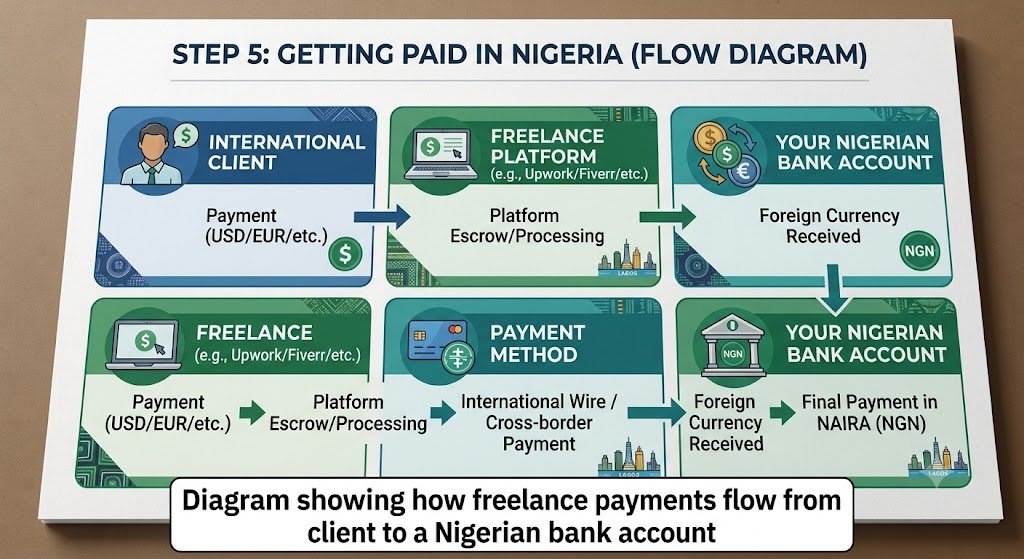
The chain: Client or platform pays in foreign currency → the money lands in a receiving account you control → you choose when to convert to naira → it arrives in your Nigerian bank. Your job is choosing each link deliberately.
The key facts, current as of 2026:
- PayPal cannot receive money in Nigeria. Nigerian PayPal accounts are send-only: fine for buying, useless for getting paid. Never select PayPal as a payout method, and avoid foreign-registered PayPal workarounds, which risk permanent freezes and lost funds.
- Payoneer is the default payout route on Upwork and Fiverr for Nigerians: you receive dollars into Payoneer, then withdraw to your Nigerian bank. It works reliably, but know the costs: conversion fees generally run around 2 to 4.5 percent, plus withdrawal charges, and an annual maintenance fee applies if you receive under a threshold in a year.
- Nigerian fintech virtual accounts are the modern alternative. Services such as Grey, Geegpay, and Cleva give you virtual USD (and sometimes GBP/EUR) account details you can add to platforms or send to direct clients, typically with more competitive naira conversion rates and faster local withdrawals than the default routes. Compare current rates and fees before choosing; they change.
- Wise is valued for transparent, near mid-market conversion when comparing costs closely, and domiciliary accounts at Nigerian banks receive raw dollars but carry SWIFT fees and maintenance costs that make them poor choices for small, frequent payments.
- Smart practice: many experienced freelancers hold part of their earnings in dollars and convert to naira periodically rather than instantly, managing exchange-rate swings, and they never keep large balances sitting in any single third-party wallet.
- Tax is real. Freelance income is taxable in Nigeria, and under the tax reforms taking effect in 2026, freelancers are expected to declare foreign income. Keep simple records of every payment from day one; it costs nothing now and prevents problems later.
Scam armor: never pay anyone to “activate” a freelancing account or “release” earnings; legitimate platforms and payment services charge fees from transactions, not upfront. Off-platform payment requests from platform clients, cheque-overpayment tricks, and “training fees” for guaranteed jobs are the classic traps.
Step 6: Win Your First Three Clients
The first three clients are the hardest and the most important; they convert your samples into testimonials and your profile into a track record. The playbook:
- Go small and specific. Target smaller jobs and smaller clients where competition is thinner, and decisions are fast.
- Personalize every pitch. Reference the client’s actual project or business in your first line; template pitches are deleted on sight. A working structure: one line showing you understood their need, two lines on how you would approach it, a link to your most relevant sample, and a clear next step.
- Volume with standards. Send five to ten quality proposals or outreach messages daily; treat it as your job until clients replace it. Most beginners quit at rejection number fifteen; most first clients arrive between twenty and fifty.
- Over-deliver deliberately. On the first jobs, deliver early, communicate at every stage, and add one small unrequested extra. Then politely request the review or testimonial; it is the real payment for early work.
Step 7: Price, Deliver, and Grow
Pricing: research what others charge for your service at your level on the platforms, start slightly below the middle, never at the desperate bottom (rock-bottom prices attract the worst clients), and raise rates after every three to five completed jobs or strong reviews. For direct clients, quote per project, not per hour, and always confirm scope in writing, even on WhatsApp, before starting: deliverables, deadline, price, and number of revisions.
Delivery discipline: a boringly reliable freelancer outearns a talented unreliable one within months. Meet every deadline or renegotiate before it passes; never after.
Growth: reinvest early earnings in the bottleneck, usually a laptop, better data, or a paid course that deepens your skill. Add a second, related service once the first is steady (a writer adds editing; a designer adds simple video). Ask every satisfied client for a referral; repeat and referred clients are how freelancing becomes stable income rather than perpetual hunting.
Real-World Case Studies
The following composites reflect patterns seen across countless Nigerian freelance journeys. Details are illustrative.
Case Study 1: The Phone-Only Writer
A 300-level student with no laptop chose freelance writing, spent five weeks studying free resources and writing daily on her phone, and built four samples about personal finance. She landed her first ₦15,000 article from a Nigerian fintech blog found via X, used three months of local earnings to buy a used laptop, then opened an Upwork profile with her by-then eight published pieces. Within a year, international clients formed most of her income. Her sequence, local naira clients first, platform clients second, is the most repeatable beginner path in Nigeria.
Case Study 2: The Virtual Assistant Who Sent Fifty Pitches
A graduate awaiting NYSC learned virtual assistance in three weeks, created a sample “client onboarding pack” as proof, and committed to ten personalized pitches daily on LinkedIn and Upwork. Rejections and silence ran for four weeks; her first client, a UK-based coach, arrived on roughly pitch number forty-five and stayed for over a year. She later calculated her “worst month” was still her most valuable, because it built the pipeline everything else flowed from.
Case Study 3: The Designer Who Escaped the Bottom
A self-taught Canva designer priced his Fiverr gigs at the absolute minimum to attract orders, and attracted exactly the clients that minimum prices attract: endless revisions, disputes, and exhaustion for tiny pay. After ten reviews, he tripled his prices, narrowed his gig to social media templates for food brands, and lost the bad clients while keeping the serious ones. His revenue rose while his workload fell, the standard reward for specialization plus confident pricing.
Also Read | Common Scholarship Application Mistakes That Get Students Rejected
Expert Tips
- Treat the first ninety days as an apprenticeship you run yourself. Two hours of skill practice plus one hour of outreach daily, tracked in a simple notebook, outperforms bursts of motivation followed by silence.
- Niche down faster than feels comfortable. “Writer for real estate brands” wins against “writer” everywhere: in searches, in pitches, and in pricing power.
- Keep a money buffer rule from the first payment. Freelance income is irregular; save a fixed percentage of every payment before spending, and convert currency deliberately rather than the day money lands.
- Protect your ratings like capital. One avoidable bad review on a young profile costs more than the job paid; when a project goes wrong, communicate early, fix generously, and learn.
- Write everything down with clients. Scope, price, deadline, and revisions in a message both parties can scroll back to; misunderstandings, not malice, cause most freelance disputes.
- Learn continuously in public. Sharing what you are learning on LinkedIn or X builds an audience that becomes inbound clients, the highest-quality clients there are.
- Verify payment services yourself before trusting balances to them. Compare current fees and rates on official sites, enable every security feature, and move earnings to your bank on a regular schedule.
Common Mistakes to Avoid
- Learning forever, starting never. Course-hopping feels productive; only outreach produces clients. Set a start date for pitching and honor it, ready or not.
- Offering every service to everyone. Generalists get scrolled past; the fix is one skill, one niche, at least for the first six months.
- Selecting PayPal for payouts. Nigerian accounts cannot receive funds; earnings sent there simply fail to arrive.
- Paying to work. Account “activation” fees, guaranteed-job training charges, and release-of-funds payments are always scams, without exception.
- Taking platform clients off-platform early. It voids the platform’s payment protection precisely when you are most vulnerable, and violates platform rules that can end your account.
- Racing to the bottom on price. Cheapest-in-market pricing attracts high-maintenance clients and makes raising rates harder; slightly-below-mid pricing with strong samples wins better work.
- Ignoring communication between milestones. Silent freelancers make clients nervous; a two-line progress update every day or two is cheap insurance.
- Spending every payment instantly and ignoring records. Irregular income requires buffers, and taxable income requires records; both start with the first payment, not the tenth.

Frequently Asked Questions
1. Can I really start freelancing in Nigeria with no experience?
Yes. Clients buy proof, not employment history, and proof can be built in one to two weeks through self-commissioned samples and one or two strategic free projects with testimonials. Every established freelancer started at zero; the seven steps in this guide are the bridge.
2. Which freelance skill is best for beginners in Nigeria?
Freelance writing, virtual assistance, and social media management are the classic starters: learnable free in four to six weeks, sellable from a phone, and in constant demand locally and internationally. Data entry and transcription are even faster to learn; web development pays most but takes months.
3. Can I freelance with only a smartphone?
Yes, in writing, virtual assistance, social media management, transcription, and Canva-based design. Many Nigerian freelancers earned their first laptop from phone-based work; a laptop then widens your service options and speed.
4. Where can I find freelance jobs as a Nigerian?
Three channels: international platforms (Upwork’s posted jobs and Fiverr’s gig marketplace both accept Nigerians), direct clients through LinkedIn and X outreach and content, and local Nigerian businesses reached through WhatsApp, referrals, and direct approach. Working all three at once is the fastest route to first income.
5. How do Nigerian freelancers receive payment from abroad?
Through Payoneer (the default on Upwork and Fiverr, with conversion fees around 2 to 4.5 percent), or through fintech virtual dollar accounts such as Grey, Geegpay, and Cleva, which often offer better naira rates and same-day withdrawals; Wise is favored for transparent conversion costs. PayPal cannot receive money in Nigeria, so never choose it as a payout method.
6. How much can a beginner freelancer earn in Nigeria?
Honestly: little in the first month or two, while skills, samples, and pitching compound; then commonly ₦50,000 to ₦300,000 monthly within three to six months of consistent work, with international clients pushing far beyond that for developed skills. Anyone promising specific fast figures is selling something; the variable is your consistency, not a secret.
7. Do I need to register a business or pay tax as a freelancer?
You can begin as an individual, but freelance income is taxable in Nigeria, and tax reforms effective 2026 expect declaration of foreign income, so keep records of all payments from day one. As income grows, registering a business name with the CAC unlocks corporate clients and business banking; consult official FIRS/state tax guidance or an accountant when earnings become significant.
8. How do I avoid freelancing scams?
Never pay to get work: activation fees, training-for-guaranteed-jobs, and fund-release charges are always fraud. Keep platform clients and payments on-platform, distrust overpayment-and-refund arrangements, and receive money only through services you registered yourself on official websites.
9. How long before I get my first client?
With daily outreach, typically two to eight weeks; the case studies above landed between pitch twenty and fifty. The wait shortens dramatically with a niched profile, real samples, personalized pitches, and by including local Nigerian clients, who often decide fastest, in your outreach.
10. Should I quit school or my job to freelance?
No. Freelancing’s great advantage is that it starts in spare hours; build it alongside school or work until it consistently matches your needs for several months. The two-hours-daily system in this guide is designed exactly for that overlap phase.
Key Takeaways
- Freelancing in Nigeria requires no capital, certificate, or connections: one learnable skill, manufactured proof, consistent outreach, and reliable delivery are the whole machine.
- Pick one beginner-friendly skill (writing, virtual assistance, social media, transcription, design) and learn it free in four to eight weeks by producing, not just watching.
- “No experience” is solved with self-commissioned samples and one or two strategic testimonial projects, housed in a simple linkable portfolio.
- Work three client channels at once: Upwork and Fiverr, direct outreach on LinkedIn and X, and local Nigerian businesses, which often pay first and fastest.
- Master the payment chain: Payoneer as the platform default, fintech virtual accounts (Grey, Geegpay, Cleva) for better rates, Wise for transparent conversion, and never PayPal, which cannot receive money in Nigeria.
- First clients come from volume with standards: five to ten personalized pitches daily, small jobs first, over-delivery, and immediately banked testimonials.
- Keep records and know that freelance income is taxable, price above the desperate bottom, raise rates as reviews accumulate, and let repeat clients and referrals replace perpetual hunting.
Conclusion
Every working freelancer in Nigeria once stared at the same wall you may be staring at now: no experience, no clients, no obvious way in. The wall turned out to be a door with a seven-step handle: foundation, one skill, manufactured proof, presence where jobs live, a payment chain that actually works in Nigeria, three hard-won first clients, and disciplined delivery that turns them into many.
None of those steps needs permission, capital, or luck, and the first one can be finished tonight. The freelancers earning steadily a year from now are being separated from everyone else right now, not by talent, but by who opened the document, picked the skill, and sent the first imperfect pitch. The map is above. The hours are yours.
Also Read | Top 10 Fully Funded Scholarships for Nigerians to Study Abroad

