




Every year, students with excellent grades and genuine financial need receive rejection emails from scholarships they were qualified to win. Meanwhile, other students with similar grades and similar stories win those same awards. The difference is rarely brilliance. It is usually the absence of mistakes.
Here is the uncomfortable arithmetic of scholarships: committees receive far more applications than they can fund, and their first task is not selecting winners. It is eliminating applications quickly and defensibly. Missing documents, ignored instructions, generic essays, and late submissions do most of that elimination before anyone debates merit. In other words, a large share of scholarship rejection is self-inflicted, which is bad news about the past and excellent news about the future, because self-inflicted problems have self-controlled solutions.
This guide walks through the common scholarship application mistakes at every stage: choosing where to apply, preparing documents, writing essays, handling recommendations, and submitting. For each mistake, you will get the fix, not just the warning. You will also find a pre-submission checklist, realistic case studies, expert tips, and answers to the questions applicants ask most. Whether you are chasing a local bursary, a national award, or an international scholarship, the goal is the same: make sure that if you are rejected, it is never for a reason you could have prevented.
Why Scholarship Committees Reject Applications
Understanding the reader changes how you write. Scholarship reviewers, whether volunteers on a community board or staff at a large foundation, typically work through stacks of applications in a limited time. Their process usually has three layers:
- Compliance screening. Did the applicant meet eligibility rules, include every required document, and follow every instruction? Applications failing here are removed without their essays being read. In many programs, this stage alone eliminates a substantial share of applicants.
- Comparative reading. Surviving applications are scored on academics, need, essays, activities, and fit with the scholarship’s mission.
- Final selection. The top-scored applications are debated, and small differences, a memorable essay, and a specific recommendation decide the outcome.
Two lessons follow. First, perfection at stage one is free marks: it requires no talent, only care. Second, at stages two and three, the winning ingredient is fit and specificity, not general excellence. Keep both lessons in mind as we go stage by stage.
Callout: The reviewer’s question. At every stage, a committee is silently asking one thing: “If we give this person our money, will it achieve what this scholarship exists to achieve?” Every mistake in this article is a way of failing to answer that question.
Stage One Mistakes: Choosing and Planning
Also Read | How to Build a Professional CV as a Student With No Work Experience
Mistake 1: Applying to Everything, Tailoring Nothing
The spray-and-pray approach feels productive and performs terribly. Ten generic applications routinely lose to three tailored ones, because committees can identify a recycled application within a paragraph.
The fix: Build a shortlist where you genuinely match the mission, then invest deeply in each. A scholarship for future teachers wants to hear about your classroom ambitions, not a general story of hard work.
Mistake 2: Ignoring Small and Local Scholarships
Everyone chases the famous national and international awards, where acceptance rates are brutal. Local awards from community groups, religious bodies, professional associations, state programs, and companies attract far fewer applicants, and several small awards can equal one large one.
The fix: Search locally first: your school’s bursary office, your state or local government schemes, your parents’ employers and unions, community foundations. Lower competition is a strategy, not a compromise.
Mistake 3: Starting at the Deadline
Rushed applications produce every other mistake on this list: missing documents, unproofread essays, and referees given two days’ notice.
The fix: Work backward from each deadline and start at least four to six weeks out: week one for documents and referee requests, weeks two and three for essay drafts, week four for review and early submission. A simple spreadsheet of deadlines, requirements, and status turns chaos into a checklist.
Mistake 4: Falling for Scholarship Scams
Any “scholarship” that charges an application fee, guarantees an award, or requests bank details or payments to “release funds” is a scam. Legitimate scholarships never ask you to pay to apply or to receive money.
The fix: Apply only through official organization websites, verify unfamiliar programs independently, and treat urgency plus payment requests as an automatic red flag.
Stage Two Mistakes: Documents and Eligibility
Mistake 5: Applying While Ineligible
Committees discard applications from students outside the stated level, field, region, age, or grade requirements, and it costs goodwill for future rounds.
The fix: Read the eligibility criteria twice before investing an hour. If genuinely unsure about one criterion, email the organizers and ask; a two-line reply can save a wasted application or rescue an opportunity you assumed you’d lost.
Mistake 6: Incomplete or Wrong Documents
Missing transcripts, expired identification, unsigned forms, uncertified copies where certification was required, and documents in the wrong format or language are the leading cause of stage-one elimination.
The fix: Turn the requirements section into a literal checklist and gather documents first, not last, because transcripts and certifications can take weeks. Follow naming and format instructions exactly: if they ask for a single PDF named a specific way, that instruction is also a test.
Mistake 7: Ignoring Instructions Hiding in Plain Sight
Word limits, font requirements, specific questions to answer, and submission methods are all instructions, and exceeding a 500-word limit by 200 words tells the committee you either did not read or did not care.
The fix: Before submitting, reread the original advert line by line and confirm compliance with every stated instruction. Committees openly admit that instruction-following is a proxy for how you will treat their program.
Stage Three Mistakes: The Essay
The essay is where surviving applications are actually won and lost, and it attracts the most damaging mistakes.
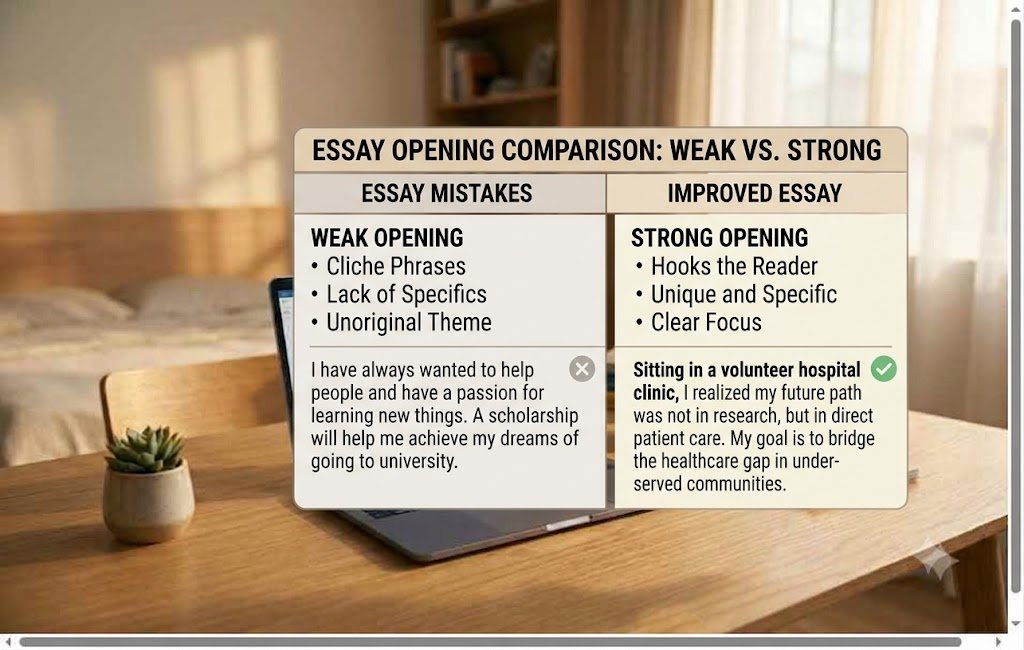
Mistake 8: The Generic Essay
“I am hardworking and passionate about education, and this scholarship will help me achieve my dreams” could be pasted into any application by any applicant, which is exactly the problem. Reviewers read dozens of versions of it per sitting.
The fix: Be specific or be forgotten. Name the moment, the project, the person, the number. Compare:
Weak: “I have always been passionate about helping my community.” Strong: “Last year I organized weekend tutoring for twelve primary pupils in my area after noticing my younger brother’s classmates could not read their own textbooks; nine of them passed their exams for the first time.”
The second version can only have been written by one person on earth, and that is the standard.
Mistake 9: Answering the Question You Wish They Asked
Prompts like “Describe a challenge you overcame and what it taught you” are frequently answered with unrelated life stories or achievement lists.
The fix: Identify every part of the prompt (the challenge, the overcoming, the lesson) and check your draft addresses each. Reviewers score against the question asked.
Mistake 10: Reciting Hardship Without Direction
Financial need matters, and honest context belongs in need-based applications. But essays that are only catalogs of suffering leave reviewers moved and unconvinced, because the reviewer’s question is about the future.
The fix: Use a simple arc: brief honest context, what you have done despite it, and precisely what their funding will make possible. Dignity plus direction beats despair every time.
Mistake 11: Unedited Writing, or Writing That Isn’t Yours
Typos and grammar errors signal carelessness. Worse are essays plagiarized from the internet or generated wholesale by AI tools: committees increasingly check, interviews expose them within minutes, and discovered dishonesty typically means disqualification, sometimes from all future rounds. Beyond the risk, a borrowed essay deletes the only advantage you have: your specific life.
The fix: Write your own first draft, then revise it at least twice with time between drafts. Reading aloud catches what eyes skip. It is legitimate to have a teacher or mentor critique your draft, and to use tools for grammar checking; it is not legitimate to submit words that are not yours as your story. If a program has rules on AI assistance, follow them exactly.
Stage Four Mistakes: Recommendations and References
Mistake 12: The Famous Stranger
Students chase impressive titles, a principal or director who barely knows them, and receive three vague sentences. Committees can smell a template letter instantly.
The fix: Choose referees who know your work personally: the teacher whose class you led, the coordinator you volunteered under. Specific stories from an ordinary title outweigh vague praise from a grand one.
Mistake 13: Ambushing Your Referees
Requests sent days before a deadline produce rushed letters or missed deadlines that sink the entire application.
The fix: Ask three to four weeks ahead, and make it easy: share the scholarship’s mission, your CV or activity list, the deadline, and submission instructions. Politely confirm a week before the due date. A well-briefed referee writes the letter you need.
Stage Five Mistakes: Submission and Follow-Up
Mistake 14: Deadline-Minute Submission
Portals crash, networks fail, and files refuse to upload in the final hours, and committees rarely accept “the website was down” at 11:58 p.m.
The fix: Treat the real deadline as 48 hours before the official one. Early submission also signals to the organization that the committee is quietly assessing.
Mistake 15: Unprofessional Contact Details and Digital Presence
A joke email address, a full voicemail box, or a public social profile that contradicts your essay can all cost an award at the final stage, since many committees check.
The fix: Use a professional email, keep your phone reachable during decision periods, and review your public profiles as a stranger would.
Mistake 16: Going Silent After Submission
Students miss interview invitations in spam folders, ignore requests for additional documents, and fail to respond to award notifications within stated windows, forfeiting scholarships they had already won.
The fix: Check email (including spam) every day or two after applying, respond promptly and courteously to everything, and if invited to interview, prepare by rereading your own application, since that is what they will ask about.
The Pre-Submission Checklist
Run every application through this list before submitting:
- [ ] I meet every stated eligibility criterion
- [ ] Every required document is included, in the required format and naming
- [ ] Transcripts, certifications, and IDs are current and correct
- [ ] The essay answers every part of the actual prompt
- [ ] The essay contains details only I could have written, and at least one number
- [ ] Word limits and formatting instructions are followed exactly
- [ ] The essay has been revised at least twice and read aloud once
- [ ] One trusted person has reviewed the full application
- [ ] Referees were briefed early and have confirmed submission
- [ ] My contact details are professional and my phone is reachable
- [ ] I am submitting at least 48 hours before the deadline
- [ ] I have saved a copy of everything I submitted
Twelve boxes. Most rejections in this article live in the gaps between them.
Real-World Case Studies
The following composites reflect patterns that scholarship administrators and school counselors describe repeatedly. Details are illustrative.
Case Study 1: Eliminated Before Reading
A high-achieving student applied to a competitive national scholarship with a strong essay, but her transcript was an uncertified photocopy where certification was explicitly required. Her application was removed at compliance screening; the essay was never read. The following year, she gathered documents six weeks early, submitted five days ahead, and won a comparable award. Nothing about her merit changed. Her process did.
Case Study 2: One Essay, Rewritten
A student sent the same personal essay to eight scholarships and received eight rejections. A counselor had him rewrite the opening and closing of each essay around the specific mission of each funder, a teaching-focused version for an education fund, a community-service version for a foundation, keeping the same core story. Three of his next six applications reached interviews, and one became an award. The story was always good; it finally started answering each committee’s actual question.
Case Study 3: The Referee Who Was Ready
Two classmates applied for the same corporate scholarship. One asked her physics teacher a month early, attaching her activity list and the scholarship’s goals; his letter cited her leadership of a named project with results. The other asked a busy vice-principal three days before the deadline and received four generic lines. Interviewers later told the winner her recommendation letter was the most specific in the pool. Referees do not write great letters alone; applicants set them up to.
Also Read | Analysis of the 2005 Appropriation Bill and Budget: Economic Impact Review
Expert Tips: How to Avoid Scholarship Rejection
- Build a reusable application pack. Keep certified transcripts, ID copies, a maintained CV, a bank of your key stories with numbers, and referee contacts in one folder. Each new application then starts at 60 percent complete.
- Track everything in one spreadsheet. Columns: scholarship, deadline, requirements, referee status, submission date, outcome. Applications fail due to forgetting.
- Recycle intelligently, never blindly. Reuse your core stories; rewrite the framing for every mission. Ten minutes of tailoring is the highest-return work in the entire process.
- Read past winners where available. Many programs publish winner profiles or essays; they reveal what the committee actually rewards better than any advice article.
- Treat rejection as data. Where feedback is offered, request it. Where it is not, audit against this article’s stages: most applicants can locate their own leak within minutes.
- Apply again. Many scholarships allow reapplication, and committees notice growth between cycles. Persistence across rounds is one of the most common traits of eventual winners.
- Tell the truth everywhere. Inflated grades, invented activities, and ghost-written essays are discovered at interviews, verification, or renewal, and the consequences outlast the application. Your real story, told specifically, is enough; this entire guide exists to help it compete.
Frequently Asked Questions
1. What are the most common scholarship application mistakes?
Missing or incorrect documents, ignored instructions, generic recycled essays, essays that dodge the actual prompt, weak or rushed recommendation letters, late submission, and applying while ineligible. Most rejections trace to these preventable causes rather than to a lack of merit.
2. Why do good students get rejected from scholarships?
Because the first screening stage tests compliance, not brilliance. Strong students who submit incomplete, non-compliant, or generic applications are eliminated before their merit is ever compared, while equally qualified students who follow every instruction advance.
3. How can I avoid scholarship rejection?
Start four to six weeks before each deadline, verify eligibility, gather documents first, tailor every essay to the funder’s mission with specific personal details, brief referees early, run the twelve-point checklist in this guide, and submit 48 hours ahead of the deadline.
4. How important is the scholarship essay really?
Among applications that survive compliance screening, the essay is usually the biggest differentiator, because grades and documents cluster closely at the top. A specific, honest essay that answers the exact prompt routinely beats a polished generic one.
5. Can I use the same essay for multiple scholarships?
You can reuse your core story, but you must reframe it for each scholarship’s mission and prompt. Identical essays are easy to spot and score poorly on fit, which committees weigh heavily.
6. Is it okay to use AI tools for my scholarship essay?
Follow each program’s stated rules first. As a general principle, using tools to check grammar or to get feedback on your own draft is reasonable where permitted, but submitting an essay you did not substantially write is dishonest, is increasingly detectable, collapses at interview, and discards your only unique asset: your real experience.
7. What if I miss a scholarship deadline?
Assume the opportunity is closed for this cycle; extensions are rare. Note the program for next cycle, set an early reminder, and redirect effort to open applications. Building your reusable application pack ensures a missed deadline never repeats for the same reason.
8. Do small local scholarships really matter?
Yes. They have fewer applicants, more approachable committees, and a stack: several modest awards can cover what one famous scholarship would. They also build a track record that strengthens later national and international applications.
9. Who should write my recommendation letters?
People who know your work firsthand and can tell specific stories: a subject teacher, project supervisor, or volunteer coordinator. Give them your CV, the scholarship’s mission, and at least three weeks’ notice. Specific detail from an ordinary title beats vague praise from an impressive one.
10. I was rejected. Should I apply again next year?
In most cases, yes, if you remain eligible. Request feedback where available, fix the stage where your application likely leaked, add a new achievement or activity, and reapply. Committees frequently reward visible growth, and many winners succeeded on a second or third attempt.
Key Takeaways
- Most scholarship rejections are preventable: compliance failures, generic essays, and rushed processes eliminate more applicants than lack of merit ever does.
- Committees screen for instruction-following first; perfect compliance is a free advantage available to every applicant.
- Specificity wins essays: named moments, numbers, and details only you could write, aimed directly at the prompt and the funder’s mission.
- Referees write great letters when briefed early with your CV and the scholarship’s goals; ambushed referees write generic ones.
- Submit 48 hours early, keep contact details professional, and stay responsive after submission; scholarships are lost even after they are won.
- Small local scholarships are a strategy: lower competition, stackable awards, and a growing track record.
- Honesty is non-negotiable; your real story, told specifically and on time, is the most competitive application you can make.
Conclusion
Scholarship committees do not reject students. They reject applications, and the difference between those two sentences is the entire message of this guide. The student is talented, deserving, and full of potential; the application is late, generic, or missing a certified transcript, and only one of the two is in the committee’s hands.
The encouraging truth is that every mistake described here sits within your control: the calendar you start early, the instructions you read twice, the essay only you could write, the referee you brief properly, and the checklist you run before submitting. Master the process, and rejection, when it still comes, becomes what it should be: a numbers game to be played again with better odds, rather than a verdict on your worth. Somewhere on a committee’s table next season is a stack of applications, and the version of yours built with this guide belongs in the small pile that survives to the end.
Also Read | How Artificial Intelligence Is Transforming Education in 2026

