



“Experience required.” Two words that make every student’s heart sink, usually followed by a familiar question: ” How am I supposed to get experience if every job needs experience first?
Here is the truth recruiters rarely say out loud: nobody expects a student CV to list years of employment. What they expect is evidence. Evidence that you can learn, show up, finish things, work with people, and communicate clearly. Most students already have that evidence scattered across their coursework, projects, volunteering, and campus life. They just have not learned how to translate it into the language a CV speaks.
That translation is a skill, and this guide teaches it completely. You will learn how to structure a CV with no work experience, what to include and exclude, how to turn ordinary student activities into professional-sounding proof, and how to write the summary and bullet points that make recruiters keep reading. You will also get worked examples, a fill-in framework, the mistakes that quietly disqualify student applications, and answers to the questions students ask most.
By the end, “no work experience” will stop feeling like an empty page and start looking like what it really is: a formatting problem with a known solution.

What Recruiters Actually Look For in a Student CV
Before writing anything, understand your reader. Recruiters and hiring managers reviewing entry-level applications typically spend well under a minute on a first pass, and they are scanning for four things:
- Relevance: Does anything here connect to the role or field?
- Evidence of skills: not claims (“hardworking”), but proof (things done, made, led, or achieved).
- Trajectory: grades, progression, growing responsibility, initiative.
- Care: clean formatting and zero typos, because the CV is your first work sample.
Notice what is missing: a long employment history. For student and graduate roles, employers assess potential, not track record. Your CV’s job is to make your potential visible and easy to verify.
Callout: The mindset shift. You are not hiding a lack of experience. You are presenting a different kind of experience: academic, project-based, voluntary, and personal. Every section of this guide serves that reframe.
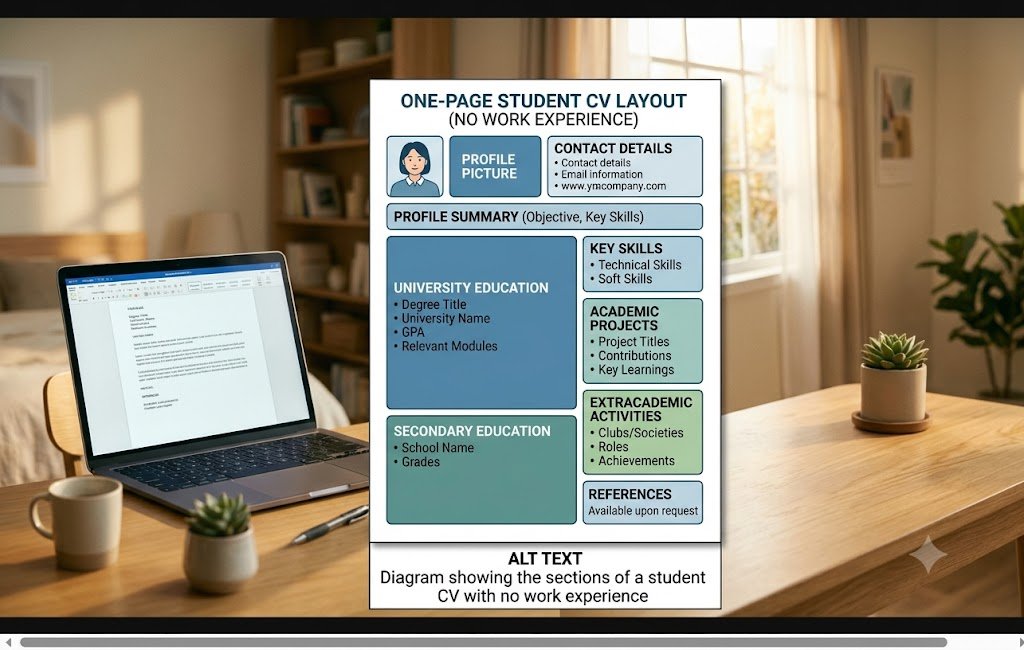
The Right Structure: CV With No Work Experience
A traditional CV leads with employment history. Yours should not, because your strongest material lives elsewhere. Use this order instead:
- Header: name, phone, professional email, city, LinkedIn (optional but useful)
- Professional Summary: 2–3 lines
- Education: your headline section, placed high
- Projects and Coursework: your substitute for job history
- Skills: technical and language skills, honestly rated
- Leadership, Volunteering, and Activities
- Certifications and Awards (if any)
- References: one line, “Available on request”
Keep it to one page. A second page on a student CV signals padding, not depth.
Should you say “no work experience” anywhere?
Never. Do not apologize, explain, or label the gap. The structure above simply removes the question by filling the page with genuine evidence. If you have even small work exposure, a weekend market stall, tutoring a neighbor’s child, a family business, or an unpaid internship, it earns a section called “Experience” and goes above Projects. Informal work is still work.
Also Read | The Story of Ambrose Alli University: How AAU Overcame Its Darkest Days
Section-by-Section Writing Guide
Header
Use a professional email built on your name (firstname.lastname@ style). An email address invented at age thirteen has ended more applications than students imagine. Do not include your photo, date of birth, marital status, or full home address unless the employer or your country’s norms specifically require them; in many markets, these invite bias and waste space.
Professional Summary
Three sentences maximum, tailored per application:
- Who you are (level and field)
- Your two or three strongest relevant skills or achievements
- What you are seeking, framed around contribution
Weak: “Hardworking student looking for any opportunity to grow.” Strong: “Final-year Accounting student with a 4.4/5.0 GPA and hands-on bookkeeping experience from managing my department association’s finances. Skilled in Excel and record reconciliation. Seeking an internship where accuracy and reliability matter.”
The strong version contains three verifiable facts. That is the pattern: facts over adjectives.
Education
For students, education carries the weight employment usually carries, so give it detail:
- Institution, course, expected graduation date
- GPA or class standing is strong (include it; omitting a good grade wastes an asset)
- 2–4 relevant modules, chosen to match the role
- A thesis or major project title, if relevant
Projects and Coursework
This is the heart of a student’s CV with no work experience. Anything counts if it produced something: a research project, a group presentation, a design portfolio, an app, a business plan for class, or a survey you conducted. Write each as you would a job:
Market Research Project — Consumer Behaviour module (Feb–Apr 2026)
- Designed and ran a survey of 120 students on food-delivery habits; analyzed results in Excel
- Presented findings to a panel of three lecturers; graded top 5 of 40 groups
Two bullets per project, each with a number where possible.
Skills
Split into Technical (software, tools, languages, lab methods) and Languages. List only what you can demonstrate in an interview within five minutes. “Familiar with” is honest and acceptable; claiming advanced Excel and freezing when asked about a VLOOKUP is not survivable.
Leadership, Volunteering, and Activities
Class representative, club treasurer, church or mosque youth coordinator, event volunteer, sports team member, peer tutor: each is evidence of soft skills employers struggle to find. Write them with the same verb-plus-result discipline as projects.
Turning Ordinary Student Life Into CV Material
Students routinely undersell themselves because they compare their activities to “real jobs.” Translate instead:
| What you did | What it proves | How to write it |
|---|---|---|
| Organized a departmental event | Planning, budgeting, and coordination | “Coordinated logistics for a 200-guest department dinner, managing a ₦150,000 budget and 6 volunteers” |
| Ran a small online store or side hustle | Initiative, sales, customer service | “Founded and ran a thrift-clothing Instagram store; handled sourcing, pricing, and 30+ customer orders monthly” |
| Tutored younger students | Communication, patience, expertise | “Tutored 4 secondary students in mathematics weekly; two improved by at least one grade in a term” |
| Managed a class WhatsApp/notice system | Reliability, communication | “Served as class information officer for 180 students, relaying schedules and deadlines for 3 semesters” |
| Group coursework | Teamwork, deadlines | “Led a 5-person team to deliver a marketing analysis one week ahead of deadline; awarded an A” |
The pattern is always the same: action verb + specific task + number + outcome. If a line has no number, hunt for one: people, money, hours, frequency, ranking, grade.
The STAR-Lite Formula for Bullet Points
Interviewers use the STAR method (Situation, Task, Action, Result). Your CV bullets should be STAR compressed to one line: Action + Context + Result.
- Start with a strong verb: led, built, organized, analyzed, designed, taught, raised, reduced.
- Add the context in a few words: what, for whom, with what constraint.
- End with the measurable result or recognition.
Before: “Was involved in the debate club.” After: “Competed for the university debate club; reached the regional semi-finals from a field of 32 teams.”
Run every bullet on your CV through this test: Could a stranger picture what I did and why it mattered? If not, rewrite.
Formatting Rules That Get You Past the First Glance
- One page. Ruthlessly.
- One clean font (such as Calibri, Arial, or Georgia), size 10.5–12, with clear section headings.
- Consistent everything: dates in one format, bullets in one style, tenses matched (past tense for finished items, present for ongoing).
- Save and send as PDF, named professionally:
Firstname_Lastname_CV.pdf. Editable Word files can break on other machines; “Document1.pdf” looks careless. - Skip heavy design templates with photos, sidebars, and graphics unless you are in a design field. Many employers use applicant tracking systems (ATS) that read plain layouts far more reliably than decorated ones, and human reviewers prefer scannable simplicity too.
- Mirror the job advert’s language. If it asks for “data analysis” and you wrote “worked with numbers,” update your wording; both ATS filters and humans match keywords.
- Proofread three ways: spellchecker, reading aloud, and one other human. A single typo undercuts a page of achievements.
Worked Examples and Case Studies
The following composites reflect patterns career advisers see constantly. Details are illustrative.
Case Study 1: The “Empty” CV That Wasn’t
A 200-level Computer Science student insisted she had nothing to write. Twenty minutes of questioning uncovered: a class project building a student attendance tracker, informal repair of coursemates’ laptops, membership in a coding club, and a Coursera Python certificate. Rewritten around a Projects section and a Skills section, her one-page CV won her a campus IT support volunteer role, which became the “Experience” section of her next CV. The material existed; only the translation was missing.
Case Study 2: The Side Hustle She Almost Left Off
A student selling snacks in her hostel considered it too informal to mention. Reframed as “Founded a hostel food business serving 40+ regular customers; managed procurement, pricing, and daily cash records for 18 months,” it became the strongest line on her CV and the topic interviewers asked about most. Employers hiring entry-level staff prize initiative precisely because it cannot be taught.
Case Study 3: The Tailoring Experiment
A graduate sent one generic CV to 15 openings: two responses. He then rewrote his summary and reordered his bullet points for each application, matching each advert’s top three requirements: five responses from the next 15. Same person, same history. Tailoring is not optional decoration; it is the difference between describing yourself and answering an employer’s question.
Expert Tips
- Build a master CV first. Keep a private two-page document of everything you have ever done. For each application, copy it and cut it down to one targeted page. Tailoring takes ten minutes when the raw material already exists.
- Collect numbers as you go. After every event, project, or role, note the figures immediately: attendance, budget, grades, and rankings. Memory fades; records don’t.
- Ask lecturers and supervisors for specifics. A referee who can say “she led the top-graded project in my class” is worth more than a famous name who barely knows you.
- Use free certifications strategically. Short courses from providers like Google, Coursera, or your national ITF/skills programs signal self-driven learning, but two relevant certificates beat ten random ones.
- Update LinkedIn to match. Recruiters cross-check. An empty or contradictory profile undermines a polished CV; a consistent one reinforces it.
- Get one honest review before sending. A career services office, a lecturer, or a working graduate will catch in five minutes what you cannot see after ten drafts.
- Write the cover letter, the CV cannot. The CV proves; the letter connects, explaining specifically why this employer and what you would bring. Never send the same letter twice with only the company name changed; reviewers can tell.
Common Mistakes to Avoid
- Apologizing for inexperience, in the summary, or anywhere else. Confidence is stating your evidence; the reader already knows your career stage.
- Padding with filler: hobbies with no relevance (“watching movies”), primary school achievements, or listing “Microsoft Word” as a headline skill. Every line must earn its space.
- Lying or inflating. Claiming skills, grades, or roles you cannot back up collapses in interviews and, in many organizations, ends candidacies permanently, even after hiring. Honesty and modesty always outperform impressive and falseness.
- One CV for every application. Generic applications get generic results, as the tailoring case above shows.
- Dense paragraphs instead of bullets. Recruiters scan; walls of text go unread.
- Decorative templates that fight ATS software: text in images, tables, columns, and icons can render your CV unreadable to screening systems.
- Unprofessional contact details: joke emails, missing phone numbers, or voicemail boxes that are full.
- Ignoring the advert. If it asks for a CV and cover letter, and you send only a CV, you have failed the first step of the job.
Also Read | How Artificial Intelligence Is Transforming Education in 2026
Frequently Asked Questions
1. How do I write a CV with no work experience at all?
Lead with education, then a Projects and Coursework section written like job entries, then skills, leadership, and volunteering. Use the action-context-result formula with numbers. The structure in this guide replaces employment history with academic and activity-based evidence, which is exactly what entry-level employers expect.
2. How long should a student’s CV be?
One page. Employers reviewing entry-level applications scan quickly, and a single tight page reads as focused, while two thin pages read as padded. Graduates with substantial internships may eventually justify more; students almost never do.
3. What skills should I put on a student’s CV with no work experience?
Only skills you can demonstrate: software and tools you actually use, languages you actually speak, and methods from your coursework. Show soft skills (teamwork, leadership, communication) through your bullet points and activities rather than listing them as bare words, which recruiters ignore.
4. Should I include my GPA or grades?
Include them if they are good for your context (for example, a strong class standing or GPA); omit them if weak, and let projects and activities carry the weight instead. Never falsify a grade; transcripts are checked.
5. Do side hustles and informal jobs count as experience?
Yes, emphatically. A market stall, online store, tutoring arrangement, or family business role demonstrates initiative, reliability, and customer skills. Present it with the same professional format and numbers as any job, under an “Experience” heading.
6. Should I put a photo on my CV?
In most markets, and for most corporate employers, no; it invites bias and wastes space, and many ATS systems handle it badly. Exceptions exist in some countries and industries, so check the norms of the specific employer and region, and follow any instructions in the advert.
7. What is an ATS, and why does it matter for my CV?
An applicant tracking system is software that many employers use to store and filter applications, often matching CVs against keywords from the job advert. Plain, well-structured layouts with standard headings and wording mirrored from the advert pass through cleanly; heavily designed templates often do not.
8. Do I need a cover letter as a student?
If the advert asks for one, it is mandatory. Even when optional, a short tailored letter (three paragraphs: why this role, your matching evidence, what you would contribute) frequently separates you from candidates who skipped it.
9. What are references, and who should mine be?
References are people employers may contact to verify you: typically a lecturer, project supervisor, volunteer coordinator, or someone you worked under informally. Ask their permission first, and on the CV itself, simply write “References available on request” to save space.
10. How do I get experience if every job wants experience?
Manufacture it: campus roles, volunteering, competitions, open-source or personal projects, free certifications, and short internships (including unpaid or virtual ones where feasible for you). Each one becomes a CV line within weeks. The students who escape the experience trap are those who treat student life itself as a portfolio under construction.
Key Takeaways
- Employers reading student CVs assess potential and evidence, not employment history; structure your CV so education, projects, and activities carry the proof.
- Never apologize for or mention lacking experience; fill the page with what you have instead.
- Translate ordinary student life, coursework, side hustles, clubs, volunteering, into professional language using the action + context + result formula, with a number in nearly every bullet.
- Keep it to one clean, ATS-friendly page, saved as a professionally named PDF, and proofread by another human.
- Tailor the summary and bullet order for every application; generic CVs produce generic silence.
- Maintain a master CV and collect numbers continuously, so each application takes minutes, not days.
- Honesty is a hard rule: modest and true beats impressive and false, in the interview and in the job.
Conclusion
A blank employment section is not a blank CV. Every student who has completed coursework, joined anything, helped anyone, sold anything, or built anything already owns the raw material employers want to see; the only real gap is translation, and translation is a learnable skill, which you now have.
Start tonight with the master CV: one document, everything you have ever done, numbers attached. From it, your first tailored one-page CV is an hour’s work, and every application after that gets faster. The students who win entry-level roles are rarely the ones with secret experience. They are the ones who learned, earlier than their classmates, how to show what they already had.
Also Read | Analysis of the 2005 Appropriation Bill and Budget: Economic Impact Review

