



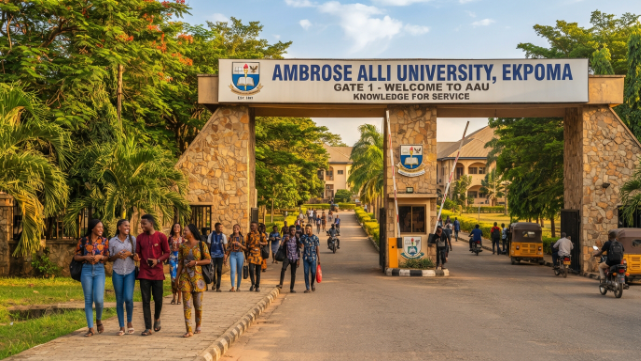
Some universities are built by governments. A few are built by conviction. Ambrose Alli University in Ekpoma, Edo State, Nigeria, belongs to the second group, which is exactly why its near-collapse hurt so many people so deeply, and why its recovery matters far beyond one campus.
Between 2016 and 2024, AAU lived through almost every crisis that can hit a public university: lost program accreditation, salary arrears stretching into years, prolonged strikes, rapid leadership turnover, and a bitter standoff between staff unions and the state government. Lecturers died waiting for salaries, according to their union. Students in professional programs watched their futures stall. At the lowest point, a proud institution that once ranked among Nigeria’s better universities was running on a fraction of the funding it needed.
Yet the story did not end there. Since late 2024, AAU has been pulling itself back: regaining accreditation, restoring governance structures, and rebuilding trust, even as debates about the past continue.
This article tells the story of Ambrose Alli University honestly, without taking sides in its political disputes. More importantly, it draws out the lessons: what students and parents should check before choosing any university, what the crisis teaches education professionals about institutional governance, and how AAU overcame its darkest days. Whether you are an AAU alumnus, a prospective student, or someone who cares about public education, there is something here for you.
The Founding Vision: One Man’s Gamble on Education
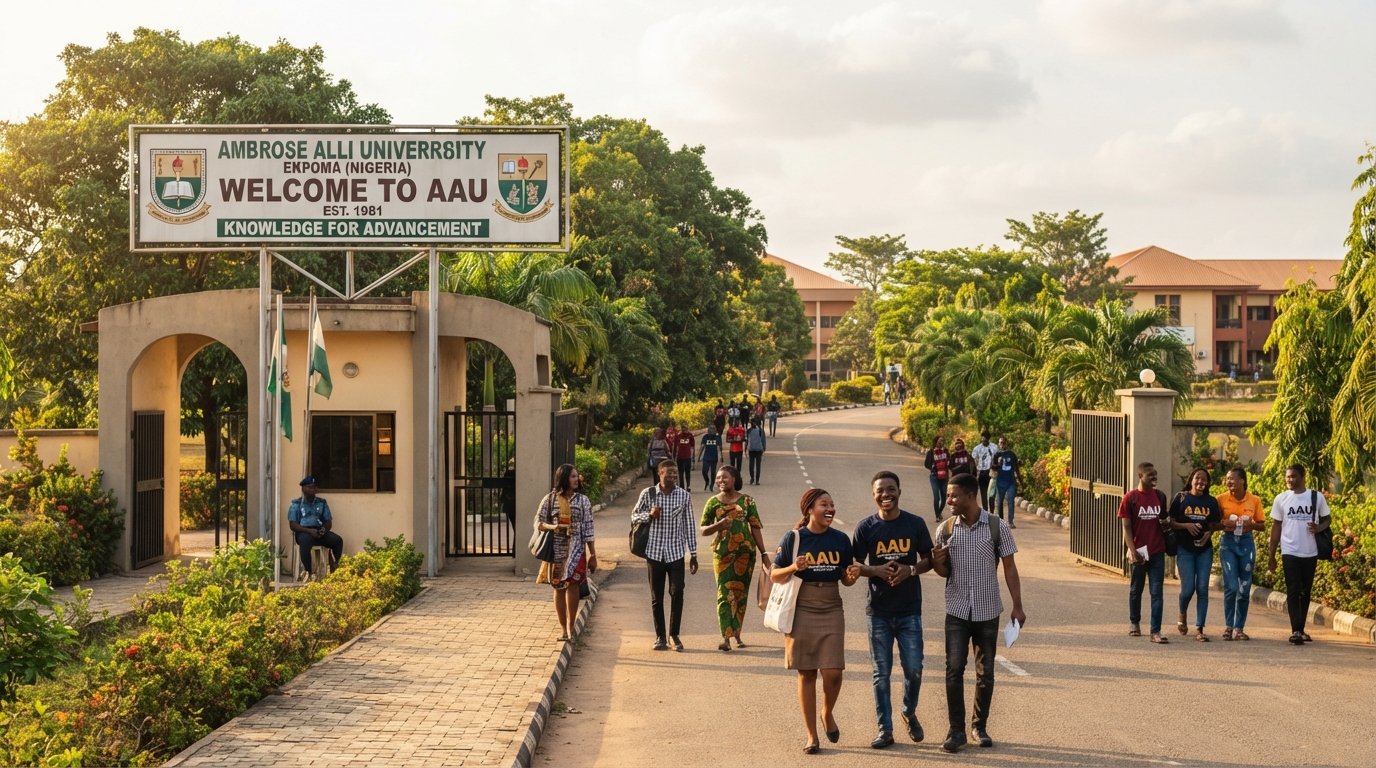
In 1981, Professor Ambrose Folorunsho Alli, then the civilian governor of the old Bendel State, did something unusual for a Nigerian state at the time: he established a state-owned university. It opened as Bendel State University in Ekpoma, a town in the Esan heartland, rather than in the state capital.
Alli was not a career politician making a symbolic gesture. He was a professor of morbid anatomy who believed that access to higher education should not depend on winning a place in the small number of federal universities. Accounts preserved in the university’s own institutional history describe him attending planning sessions personally and pushing infrastructure work forward so students could resume at the permanent site. By the 1982/83 session, the vice-chancellor was so encouraged by progress that he titled his matriculation address “The Promised Land.”
That phrase would prove prophetic in a way nobody intended. Reaching the promised land turned out to be easier than staying there.
Why a State University Mattered
To understand the founding, it helps to understand the context. In the early 1980s, Nigeria’s federal universities could not absorb the growing number of qualified school leavers. A state university meant more admission slots, programs shaped by local needs, and opportunities for communities far from the established academic centers. Ekpoma, a modest town, was transformed economically and socially by the campus. Landlords, traders, transport workers, and food vendors all built livelihoods around the student population, which is one reason the later crises hit the whole town, not just the campus.
Three Names, One Institution
The university’s changing name traces Nigeria’s changing political map:
| Period | Name | Reason |
|---|---|---|
| 1981–1992 | Bendel State University | Founded by Bendel State under Governor Ambrose Alli |
| 1992–1999 | Edo State University | Bendel State was split into Edo and Delta States in 1991; the university fell to Edo |
| 1999–present | Ambrose Alli University | Renamed by law under Governor Lucky Igbinedion to honor the founder |
The 1999 renaming was more than sentiment. Professor Alli had been jailed by a military tribunal after the 1983 coup and died in 1989 with his reputation still under a cloud that many Edo people considered unjust. Naming the university after him was a public act of restoration, and it bound the institution’s identity permanently to his legacy. That is worth remembering, because critics of later governments repeatedly framed the university’s decline as a betrayal of Alli himself.
Also Read | How Artificial Intelligence Is Transforming Education in 2026
The Slow Slide: How the Trouble Began
Institutions rarely collapse overnight. AAU’s crisis built up over roughly a decade.
Accreditation Warnings
Accreditation is the quality-assurance process by which Nigeria’s National Universities Commission (NUC) and professional bodies certify that a program has the staff, facilities, and curriculum to graduate competent professionals. Losing it is the clearest external signal that a university is in trouble.
By 2016, the warning lights were flashing. Six AAU programs, including microbiology, biochemistry, and political science, failed NUC accreditation that year, a development that drew sharp public criticism of the state government’s funding priorities. Commentators noted that the university had reportedly requested about ₦1.2 billion to prepare its courses for accreditation and did not receive it. One widely cited comparison in the Nigerian press held that AAU had fallen from 19th position in NUC’s 2011 rankings to 57th within about five years.
Professional accreditation slipped too. The Council for the Regulation of Engineering in Nigeria (COREN) later disclosed that accreditation for AAU’s mechanical and electrical/electronics engineering programs had expired in November 2020 and had not been renewed, meaning the university was running engineering programs on expired status.
Funding and Governance Strain
Underneath the accreditation problem sat two deeper issues that afflict many state universities: inconsistent funding and politicized governance. Subventions fluctuated with state politics. Governing councils were dissolved or left vacant. Vice-chancellors changed frequently, with three different acting vice-chancellors between 2021 and 2024 alone. Each change reset priorities and relationships, making long-term planning nearly impossible.
The Darkest Days: 2021 to 2024
If the decline was slow, the crisis years were brutal.
Strikes and Unpaid Salaries
In March 2021, the AAU chapter of the Academic Staff Union of Universities (ASUU) began an indefinite strike over unpaid salaries and governance concerns, saying its memos to the state government had gone unanswered. By mid-2022, the union said workers had gone 19 months without pay, and its chairman told journalists that around ten lecturers had died during the strike period, with some unable to afford medical care. As late as November 2024, the union maintained that some academic staff had been denied salaries for up to 34 months, a claim the university administration disputed.
The state government told a very different story. It insisted that arrears had been cleared, pointing at one stage to about ₦3.8 billion paid to roughly 2,062 staff during 2022, and argued that the previous management had run the university aground with over a billion naira in unpaid obligations. Both accounts cannot be fully right, and this article does not pretend to adjudicate between them. What is beyond dispute is the human cost: prolonged industrial conflict, disrupted academic calendars, and staff and students caught in the middle.
The Special Intervention Team
In 2021, Governor Godwin Obaseki, with approval from the Edo State House of Assembly, set up a Special Intervention Team (SIT) to take charge of repositioning the university. The government framed the SIT as a rescue mission. The campus unions saw it as an occupation: ASUU and the non-academic unions opposed it from the start, and the Benin Zone of ASUU publicly faulted the arrangement of running a university without a governing council as alien to university administration anywhere in the world.
The conflict deepened when the interim management disengaged staff, with reports of over 90 workers removed in one round in 2023, and when the SIT’s final report accused sections of the university community of financial misconduct, allegations the unions rejected and turned back on government appointees. Whatever one’s view of the SIT, this period illustrates a hard truth of institutional crisis: emergency measures imposed without buy-in tend to multiply grievances even when they fix balance sheets.
The Human Dimension
Behind every headline were ordinary people. Final-year students in programs with lapsed accreditation faced uncertainty about whether their degrees would be recognized by professional bodies. Medical students experienced long delays in their training pipeline. Families in Ekpoma whose incomes depended on a functioning campus endured lean years each time the gates effectively closed. When people ask why university governance matters, AAU’s crisis years are the answer.
The Turning Point: How AAU Overcame Its Darkest Days
Recovery began with a change of government and, more importantly, a change of approach.
New Leadership, New Priorities
Governor Monday Okpebholo took office in November 2024 and made AAU an early priority. Reporting and commentary from 2025 describe the situation he inherited in stark terms: monthly funding that had fallen to about ₦41 million, lost accreditation in core programs, disengaged staff, and medical students stranded mid-training. The recovery agenda focused on four fronts:
- Restoring funding so the university could pay its people and maintain its facilities.
- Rebuilding governance, returning the university to conventional structures, a functioning council, and a substantive leadership pipeline. The university is now led by Vice-Chancellor Professor Eunice Omonzejie.
- Regaining accreditation, with programs such as Nursing Sciences reported to be recovering their academic standing and attention given to the College of Medicine’s stranded cohorts.
- Reconciling stakeholders, including addressing the salaries and reinstatement claims of staff affected during the SIT era.
An Honest Caveat
It would be misleading to declare the story finished. As recently as April 2026, the university’s management publicly rejected fresh reports alleging a governance crisis and defended the vice-chancellor’s leadership, a reminder that institutional recovery is a process, not an event. Much of the most glowing recovery commentary has come from politically sympathetic sources, so readers should weigh it accordingly. Still, the direction of travel since late 2024, on funding, accreditation, and basic institutional functioning, represents a genuine turn from the darkest days. In June 2026, the university opened sales of admission forms for the 2026/2027 session, an ordinary act that would have felt extraordinary five years earlier.
Lessons for Students and Parents
AAU’s story is a practical education in choosing and surviving a university. Use it.
A Pre-Admission Checklist
Before accepting admission into any Nigerian university, check the following:
- Program accreditation status. Verify your specific course on the NUC website and with the relevant professional body (COREN for engineering, MDCN for medicine, NMCN for nursing, ICAN-recognized status for accounting, and so on). Never rely on the university’s overall status; accreditation is program by program.
- Academic calendar stability. Ask current students how many sessions the last four years actually took. Frequent strikes stretch a four-year degree into six.
- Salary and governance news. Search the university’s name plus words like “strike,” “arrears,” or “council” for the past three years. Ten minutes of reading can save you years.
- Professional exam performance. For professional courses, ask about graduates’ induction and licensing outcomes.
If Your University Enters a Crisis
- Document everything: receipts, results, and course registrations. Institutional records can become chaotic during crises.
- Join and follow official student channels rather than rumor networks.
- Use forced breaks deliberately: internships, certifications, remote skills courses. Many AAU students who thrived after the crisis were those who kept building during it.
- Know the transfer rules early, even if you never use them.
Lessons for Education Professionals
For administrators, policymakers, and researchers, AAU offers a compact case study in institutional failure and repair. Three lessons stand out.
First, governance structures are not bureaucratic decoration. Running a university without a governing council, or through externally imposed interim bodies, breaks the trust mechanisms that make hard decisions legitimate. Even necessary reforms fail when the people affected have no voice in them.
Second, salaries are the foundation, not a line item. No quality-assurance framework survives a workforce that is unpaid for months or years. Accreditation losses, brain drain, and industrial conflict all flow downstream from payroll failure.
Third, recovery requires both money and reconciliation. Restored funding reopened AAU’s path back, but the unresolved disputes over staff removals and arrears show that financial repair without human repair leaves an institution fragile.
Expert Tips: Evaluating a University’s Health
Education analysts commonly look at five indicators, and any parent or journalist can check them too:
- Leadership tenure. More than two vice-chancellors in five years signals instability.
- Accreditation trajectory. One failed program can be an accident; a cluster is a pattern.
- Union relations. Frequent strike notices reveal deeper funding or governance problems.
- Visitor behavior. In Nigerian state universities, the governor is the Visitor. Watch whether the state treats the university as an institution or as patronage territory.
- Ordinary signals. Regular convocations, published academic calendars, and on-time admission cycles are humble but reliable signs of a functioning university.
Common Mistakes to Avoid
- Judging a university only by its past reputation. AAU’s proud history did not protect students admitted during the crisis years. Check current conditions.
- Ignoring program-level accreditation. Students have completed entire degrees in programs whose professional accreditation had lapsed.
- Treating every media report as neutral. Coverage of AAU has often been political, in both directions. Read government sources, union statements, and independent reporting together.
- For policymakers: imposing rescue plans without stakeholders. The SIT episode shows how a repair effort can become a second crisis.
- For alumni: disengaging when the institution struggles. Alumni advocacy and support were part of the pressure that kept AAU’s plight on the public agenda.
Also Read | How to Choose the Perfect Business Model for Your Personality Type
Frequently Asked Questions
1. When was Ambrose Alli University founded and by whom?
It was founded in 1981 as Bendel State University by Professor Ambrose Folorunsho Alli, then governor of the old Bendel State. It became Edo State University after the state was split in the early 1990s and took its current name in 1999 in honor of its founder.
2. Where is Ambrose Alli University located?
In Ekpoma, Edo State, Nigeria, along the Benin–Auchi road. It is Edo State’s flagship state-owned university.
3. What caused AAU’s crisis?
A combination of chronic underfunding, unstable governance (including periods without a governing council and frequent leadership changes), unpaid salaries that triggered prolonged strikes, and accreditation failures in several programs. The crisis peaked between 2021 and 2024.
4. Did AAU really lose accreditation for some courses?
Yes. Several programs failed NUC accreditation in 2016, and COREN later confirmed that accreditation for two engineering programs had expired in 2020 without renewal. Reports on the recovery indicate programs such as Nursing Sciences have been regaining their standing since 2024/2025.
5. Is Ambrose Alli University accredited now?
The university remains recognized by the National Universities Commission, and reaccreditation of affected programs has been a central focus of the recovery effort. Because accreditation is granted program by program and changes over time, prospective students should verify their specific course directly with the NUC and the relevant professional body before accepting admission.
6. How long were AAU staff owed salaries?
Accounts differ. The lecturers’ union reported arrears of 19 months by mid-2022 and claimed some staff were owed up to 34 months by late 2024, while the state government maintained at various points that arrears had been cleared. The dispute itself, regardless of which figures one accepts, defined the darkest phase of the crisis.
7. What was the Special Intervention Team?
A body set up by the Edo State government in 2021, with legislative approval, to take over the repositioning of the university. The government presented it as a rescue measure; campus unions opposed it, and its tenure included staff disengagements and a contested report alleging financial misconduct. It was later dissolved as normal governance structures returned.
8. Who leads Ambrose Alli University today?
Professor Eunice Omonzejie serves as vice-chancellor, following a succession of acting vice-chancellors during the crisis years. Governance has returned to conventional university structures under the current state administration.
9. Is AAU a good choice for prospective students in 2026?
It depends on the program. The university is admitting students, running its academic calendar, and rebuilding accreditation. Prospective students should apply the checklist in this article: confirm their specific program’s accreditation, ask current students about calendar stability, and follow recent news. Due diligence is wise for any university, not just AAU.
10. What is the biggest lesson from AAU’s story?
That universities are held up by three pillars at once: funding, governance, and trust. Remove any one and the others eventually buckle. AAU’s recovery began only when all three were addressed together.
Key Takeaways
- Ambrose Alli University was founded in 1981 by Professor Ambrose Alli as a deliberate bet on mass access to higher education, and its identity remains tied to his legacy.
- Its decline was gradual: accreditation failures from 2016 onward signaled deeper funding and governance problems.
- The darkest days, roughly 2021 to 2024, combined multi-year salary arrears, prolonged strikes, staff deaths reported by the union, mass disengagements, and rule by an interim intervention team without a governing council.
- Recovery since late 2024 has rested on restored funding, rebuilt governance, program reaccreditation, and stakeholder reconciliation, though disputes about the past and present have not fully ended.
- For students and parents, the practical lesson is due diligence: verify program accreditation, calendar stability, and institutional news before committing years of your life.
- For institutions everywhere, AAU shows that payroll failure and governance vacuums are existential threats, and that recovery requires legitimacy, not just money.
Conclusion
The story of Ambrose Alli University is not a simple tale of villains and heroes, and any honest telling resists that temptation. It is the story of an institution founded on conviction, weakened by years of underfunding and contested governance, brought to its knees by a salary and accreditation crisis, and now working its way back to health under new leadership and renewed public attention.
Professor Alli titled that early matriculation era “The Promised Land,” and the decades since have proven the second half of the lesson his university had to learn the hard way: arriving is one thing, remaining is another. AAU’s darkest days were overcome not by a single decision but by the slow restoration of the three things every university needs: money that arrives, governance that is legitimate, and people who trust the institution enough to keep building it. That is a lesson worth carrying far beyond Ekpoma.
Also Read | How Artificial Intelligence Is Transforming Education in 2026

